
Panel Beating or Panel Replacement: How the Decision Is Made
A damaged panel is repaired when the metal is sound and the shape can be brought back, and replaced when the metal is stretched, split, folded through a pressed line, or damaged across most of the panel. You are usually being asked to approve one or the other with no explanation of why, and the two carry very different bills. The decision is made at strip down, on the panel itself, and it changes both what you pay and how long the car is off the road. This guide explains what a panel beater actually does and how the call is made on your car.
What is panel beating
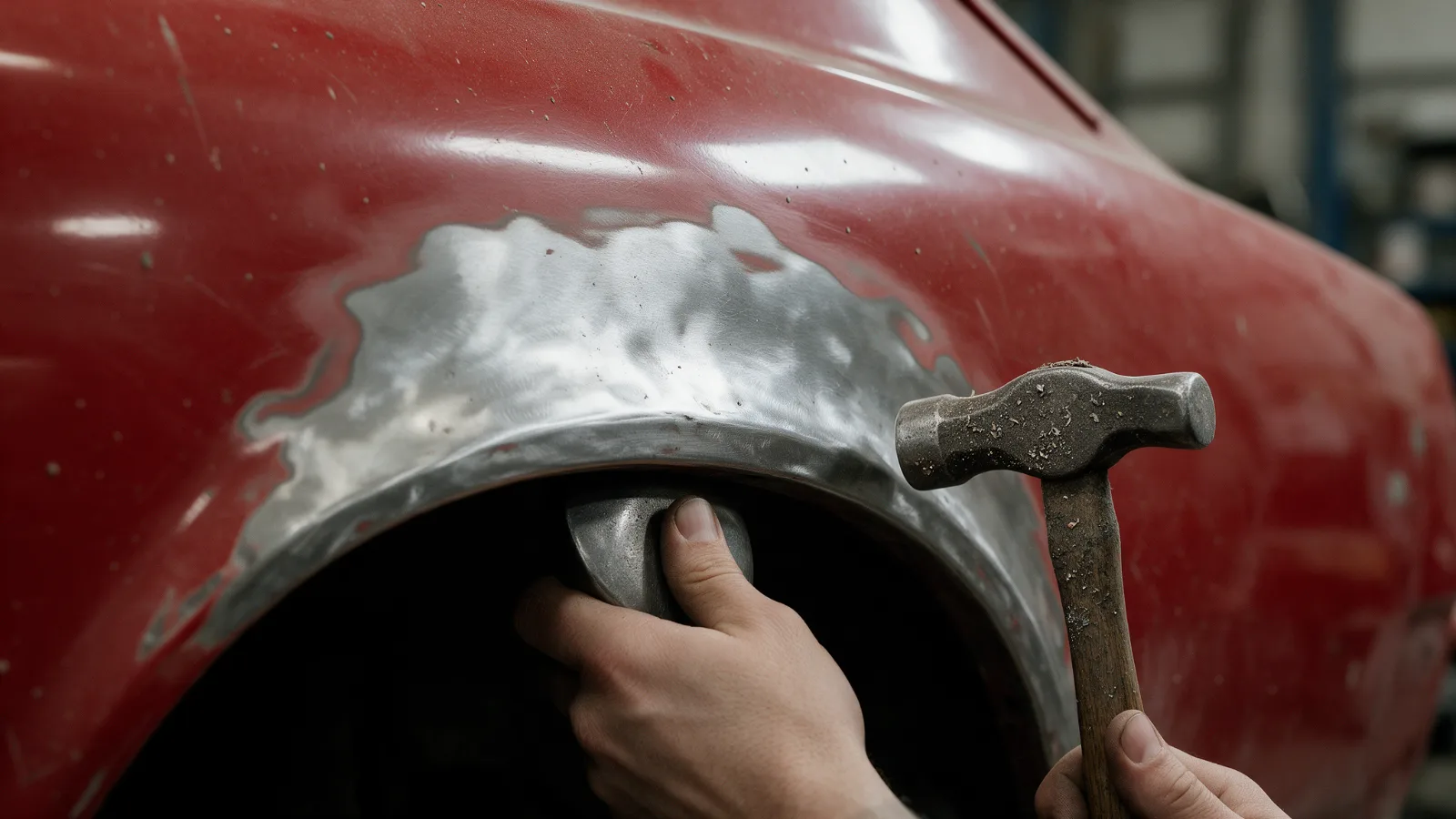
Panel beating is reshaping a damaged metal panel back to its original profile, using hand tools and heat rather than filler. The panel is worked from both sides where there is access, tapped down where it has been pushed out and pulled up where it has been pushed in, until the surface follows the same line it left the factory with. Ali Hindal does this work himself at the Rumney workshop, Unit 4 Wentloog Buildings, where the six work bays sit alongside the on-site spray booth.
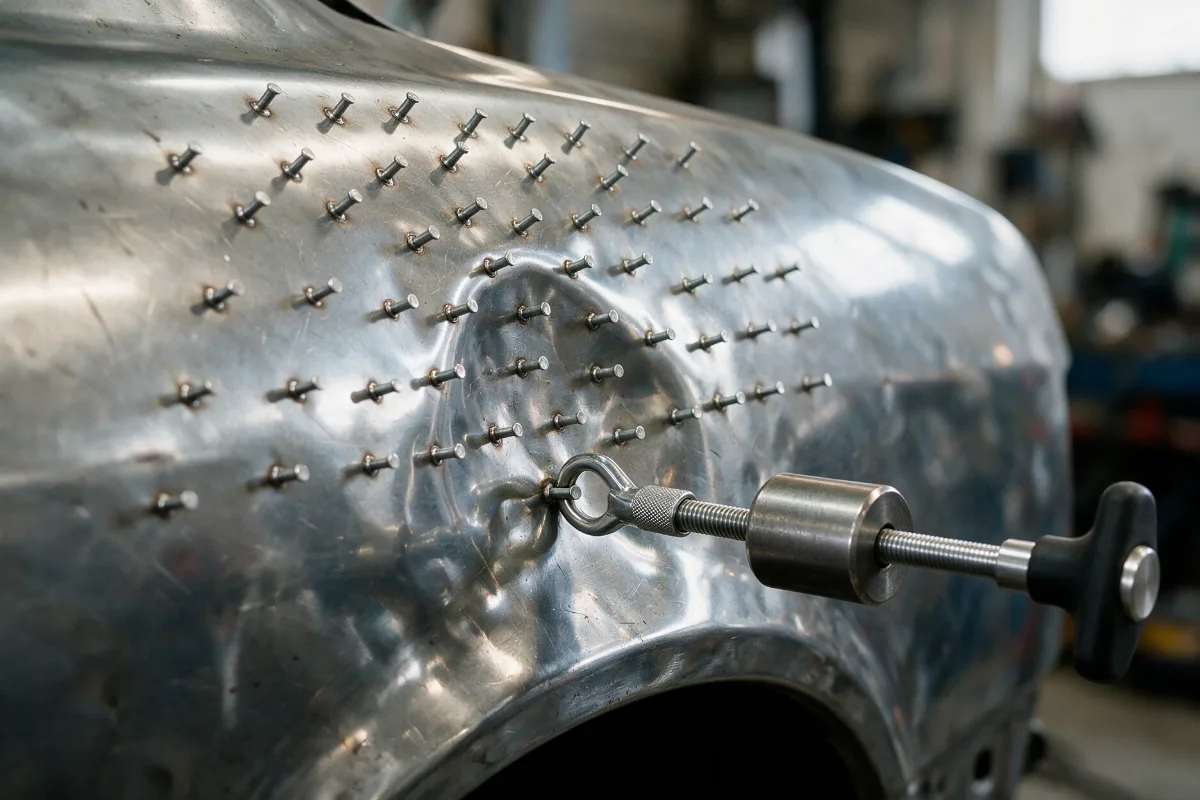
Three tools do most of it. A hammer and dolly work opposing faces of the panel at once. A stud welder welds pins to the outer skin so the metal can be pulled out where there is no access behind, which covers most modern doors and rear quarters. Shrinking, with heat, takes the stretch out of metal that has been pulled beyond its original area.
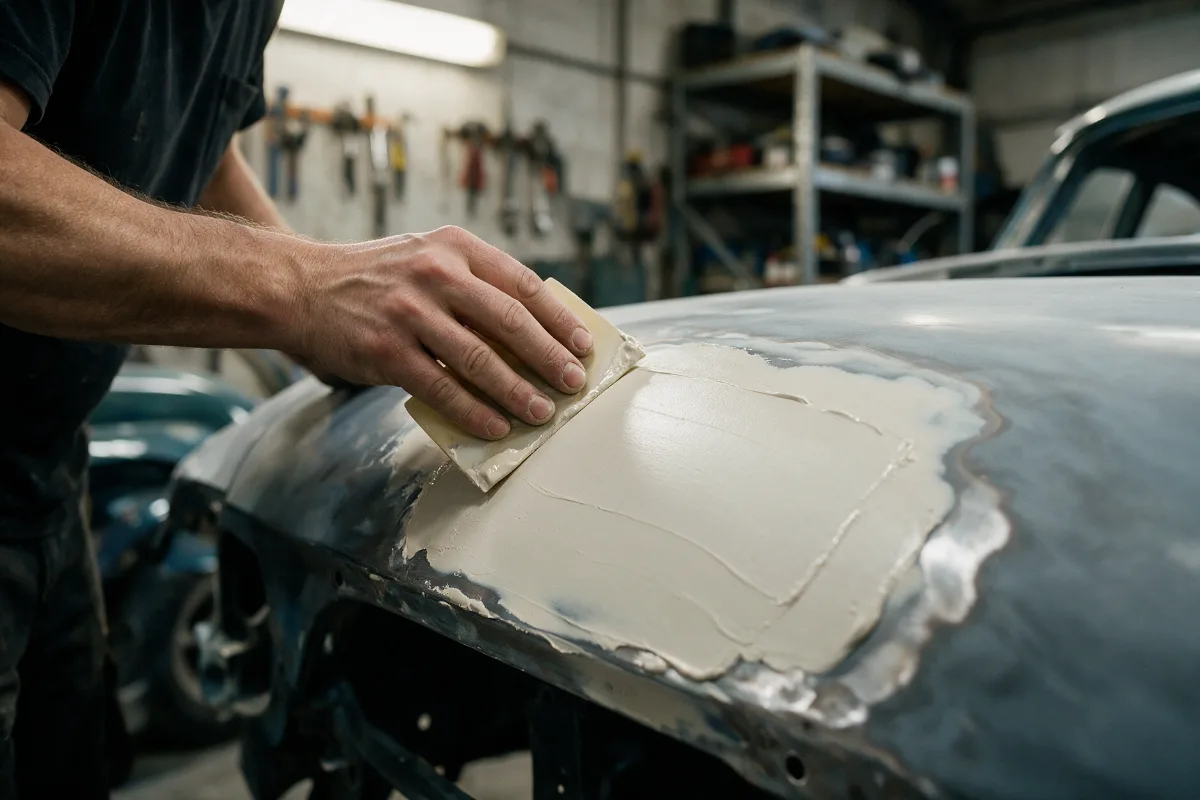
What panel beating is not is filling. Filler has a job, and that job is the last fraction of a millimetre after the metal is already in shape. A panel carrying filler thick enough to be doing the shaping will crack along the edges within a couple of winters.
Is it better to repair or replace a car panel
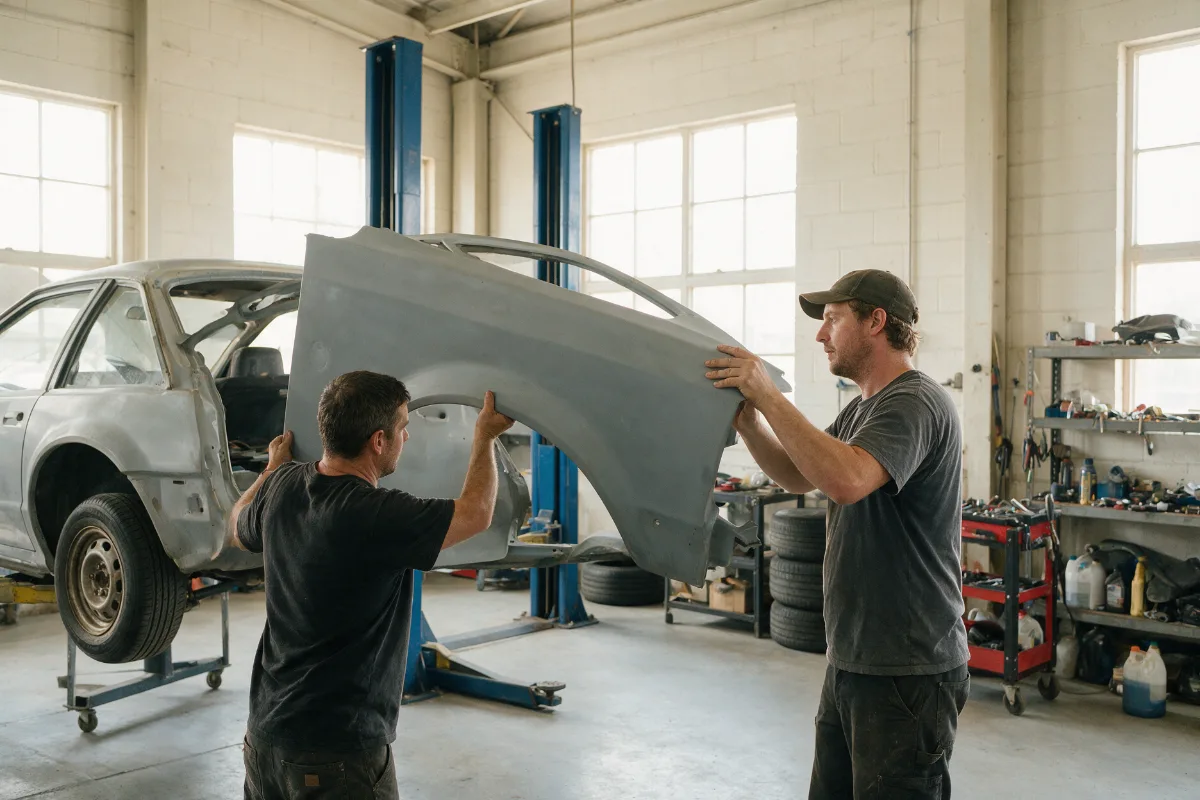
Repair is better when the metal is sound, because the car keeps its original panel, its factory seams and its original corrosion protection. Replacement is better when the metal has been stretched or torn, when a pressed line has folded, or when the damaged area covers most of the panel and the labour to repair it passes the cost of a new one.
The honest version of this answer includes a warning about the other direction. Replacement is quicker and more predictable than metalwork, so panels do get replaced where a repair would have held. That is not fraud and it is rarely worse for the car, but it costs more, and on an insurance job the extra is being paid by an insurer rather than by the driver, so it goes unquestioned.
What decides repair or replace
Five things, checked in this order: Once the damage reaches a structural member the question changes entirely, as chassis damage after an accident sets out.
- Is the metal stretched? A stretched panel has more surface than the space it occupies. Push it back and it springs, so it must be shrunk or replaced.
- Is a swage line involved? The pressed lines down a door or wing are what hold the panel’s shape. Once folded, they rarely come back true.
- What is the panel made of? Steel repairs predictably. Aluminium work hardens and cracks. Plastic is welded rather than beaten.
- How much of the panel is damaged? Past roughly two thirds, repair labour exceeds the price of a new panel.
- What sits behind it? A panel that has pushed into a brace, a mounting or a sensor bracket changes the job from skin work to structure.
Cost and time: repair against replacement
| Repair the panel | Replace the panel | |
|---|---|---|
| Where the cost sits | Labour on the panel | The part, plus paint on a bare panel |
| Time in the workshop | Longer at the metalwork stage | Shorter once the part has arrived |
| Waiting on parts | None | Days to weeks, depending on the model |
| Factory corrosion protection | Kept | Replaced, and only as good as the sealing work |
| Original factory seams | Kept | Cut and rewelded, on a welded panel |
| Effect on car history | Repair only | Replaced panel, visible to a trained buyer |
Two of those rows matter more than the rest on an older car. A car that has never had a panel off has its original seam sealer and cavity wax, and both of those are worth more over ten years than the difference in the bill. What that means in practice is set out on the bodywork repair page.
How a panel beater reads the damage
The panel is read before anything is touched. Three things are being looked for, and they decide everything that follows.
The first is the point of impact, which is rarely the lowest point of the dent. Metal moves away from where it was struck, so the damage spreads outwards in a pattern that tells you the direction and the force. Working a panel back starts at the outside of that pattern and moves inwards, in the reverse order to the way the damage happened.
The second is crown, which is how much curve the panel has. A flat panel, such as a van side or a door skin, holds its shape weakly and dents easily, but it also comes back easily. A high crown panel, like a wing over an arch, resists damage and resists repair in equal measure.
The third is whether the metal has moved or merely bent. Bent metal has kept its length and can be persuaded home. Moved, or stretched, metal has gained length, and no amount of pushing will make it fit again. On smaller marks that reading decides whether the panel needs paint at all, which is explained on dent and scratch work.
What happens on a plastic bumper instead
Bumpers are not beaten, they are welded. A crack or split in a plastic bumper skin is prepared, welded from behind with a plastic welder and matching rod, reinforced with mesh or staples where the crack runs to an edge, then filled thinly on the face and refinished.
The usual reason a bumper gets replaced rather than repaired is not the crack at all. It is the mounting points: the tabs and lugs that clip the bumper to the wings and the slam panel. Those snap on impact, and a bumper with broken tabs will never sit tight however good the repair on the face is. When we quote a bumper, those tabs are the first thing we look at. The full picture of how bumpers are assessed and repaired is on bumper repair.
How long does each route take
| Route | Typical time in the workshop | Main variable |
|---|---|---|
| Dent repaired, paint intact | 1 day | Access behind the panel |
| Panel repaired and refinished | 2 to 3 days | Colour match and cure time |
| Panel replaced, bolt on | 2 to 4 days | Parts lead time |
| Panel replaced, welded | 4 to 6 days | Cutting, welding, sealing and paint |
Parts are the reason a replacement can end up slower than a repair, even though the work itself is quicker. A wing for a common hatchback is on a shelf in Cardiff; the same wing for a facelift model in the wrong colour year can take a fortnight. The full picture for a whole job is in how long accident repair takes.
Does a repaired panel look worse than a new one
No, when it is done properly. A correctly repaired panel is flat, holds its reflection in a straight line, and carries a skim of filler thin enough to be irrelevant. Once it is primed, painted and blended, there is nothing to see.
What gives a poor repair away is filler thickness and edges. Thick filler shrinks slightly as it cures, so the repair appears weeks later as a faint hollow you can see in a reflection. Filler taken right to the edge of a panel cracks where the panel flexes. Paint that has not been blended into the neighbouring panel leaves a hard line that daylight finds from three metres away.
One look tells you, on any repair, new panel or old: stand at the end of the car, look down its length at a shallow angle with a straight edge of light reflected in the paint. A bent reflection means a bent panel, whoever fitted it.
Which do insurers prefer
Insurers prefer whichever is cheaper for the same standard of finish, which in practice means repair on smaller damage and replacement on larger damage. The assessor agrees the method as part of authorising the work, and their decision is the one that gets paid for.
Disagreements between a repairer and an assessor are usually about stretched metal, because stretch does not show in a photograph. A desktop assessment looking at three images may authorise a repair on a panel that needs replacing. We raise that before the work rather than after, with photographs, and the authorisation is revised.
On a private job you make the same decision yourself, with the figures in front of you. Both are covered under insurance claim repairs.
Getting a panel assessed in Cardiff
Send photographs and we will tell you which way the panel is likely to go, then confirm it with the panel in front of us. Damage that looks identical on two cars can need opposite answers, purely because of what the metal did on impact.
Not sure whether your panel can be saved?
Send a photograph of the damage and we will tell you honestly. Unit 4, Wentloog Buildings, Wentloog Road, Rumney, Cardiff CF3 1TH. Monday to Saturday, 9am to 6pm. Ring the workshop, or send the photographs, and we will tell you what your car needs.
Questions about panel repair and replacement
How thick can filler be before it is too thick?
A skim, not a build. Filler doing structural shaping rather than final levelling is the wrong approach, and it will crack as the panel flexes.
Can a crease be repaired?
Sometimes. A soft crease in flat metal can be worked out. A crease that has folded a pressed line usually means replacement, because the line will not come back straight.
Is a replaced panel worse for resale?
A well fitted replacement panel is not a problem on its own. What lowers value is poor alignment, mismatched colour, overspray on seals and a repair that was clearly done to be sold rather than to last.
Do you repair aluminium panels?
Aluminium needs separate tools and a separate area to avoid contaminating steel, and it cracks where steel would stretch. We will tell you whether your panel is repairable or a replacement before you commit.
Why is my quote for a repair higher than a new panel online?
The panel price online is bare metal. The quote includes paint, blending into the adjacent panel, fitting, and any clips or brackets, which is most of the cost of fitting a new panel.
Does a repaired panel rust sooner than a new one?
Not when the repair is sealed properly. Bare metal is treated before filler or primer goes near it, and the underside and any seams are resealed afterwards. A repair that rusts early is almost always one where the back of the panel was never touched, which is why we look at both sides before quoting.
Can you tell from a photograph which one my car needs?
Usually within a range. A shallow dent in flat metal is almost always repairable and a folded swage line almost never is. The cases in between need the panel in front of us, because stretch does not photograph.
Will you tell me if a repair is not the right answer?
Yes. A repair that will not last is worse than no repair, because you pay twice and the second job is bigger.
Send a photograph of the damage and we will tell you which way your panel goes, and what that means for the bill. Call 07400 454839 or use the contact form.