
Paint and Spray Repairs in Cardiff
A paint and spray repair is the refinishing of a panel or a whole car in a controlled spray booth, using the manufacturer’s paint code so the new finish sits against the old one without a visible edge. Paint is the part of bodywork that exposes shortcuts fastest, which is why a cheap job looks fine on the forecourt and wrong three weeks later in daylight. You are looking at a scuffed wing or a faded bonnet, and the question underneath it is will the repair show. Bring the car to the Rumney workshop, let Ali Hindal read the paint code and the condition of the surrounding panels, and you get a written quote after the strip down rather than a guess over the phone.

What does a paint and spray repair involve
A paint and spray repair involves four stages: preparation, priming, colour, and lacquer, each one cured before the next begins. Preparation is the longest and the least visible. The panel is flatted back, any filler is shaped and sanded, and every edge that the new paint will meet is feathered so the transition cannot be felt with a fingertip. Skip that and your repair announces itself along a hard line that catches the light every time you walk up to the car.
Priming seals the repair and gives the colour something consistent to sit on. Bare steel, old paint and filler all absorb differently, so without primer the same colour reads as three slightly different shades across one panel. Colour goes on in thin coats, each one flashed off before the next, and lacquer goes over the top to carry the gloss and the UV protection.
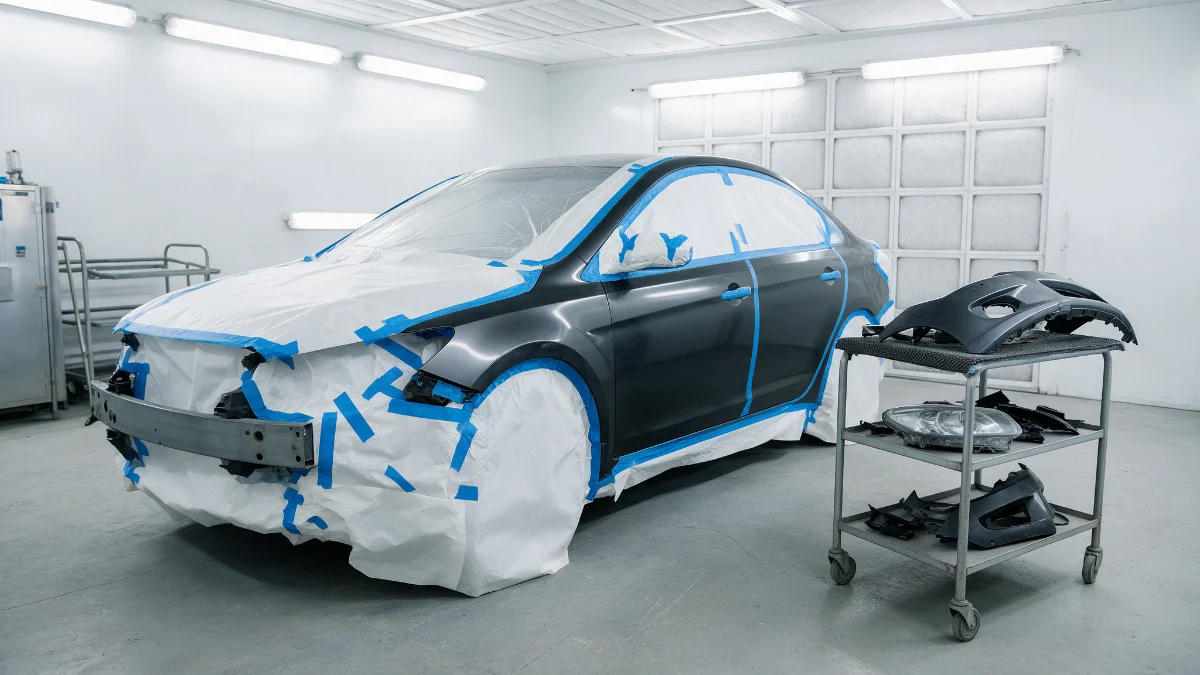
All of it happens in the on-site spray booth at Unit 4 Wentloog Buildings, where the air is filtered and the temperature is held steady. A panel sprayed in an open workshop picks up dust, and dust under lacquer is permanent, so you live with it for as long as you own the car. The bodywork that happens before the paint, the beating, pulling and panel replacement, is set out on bodywork and panel repairs.
Will the new paint match the rest of the car
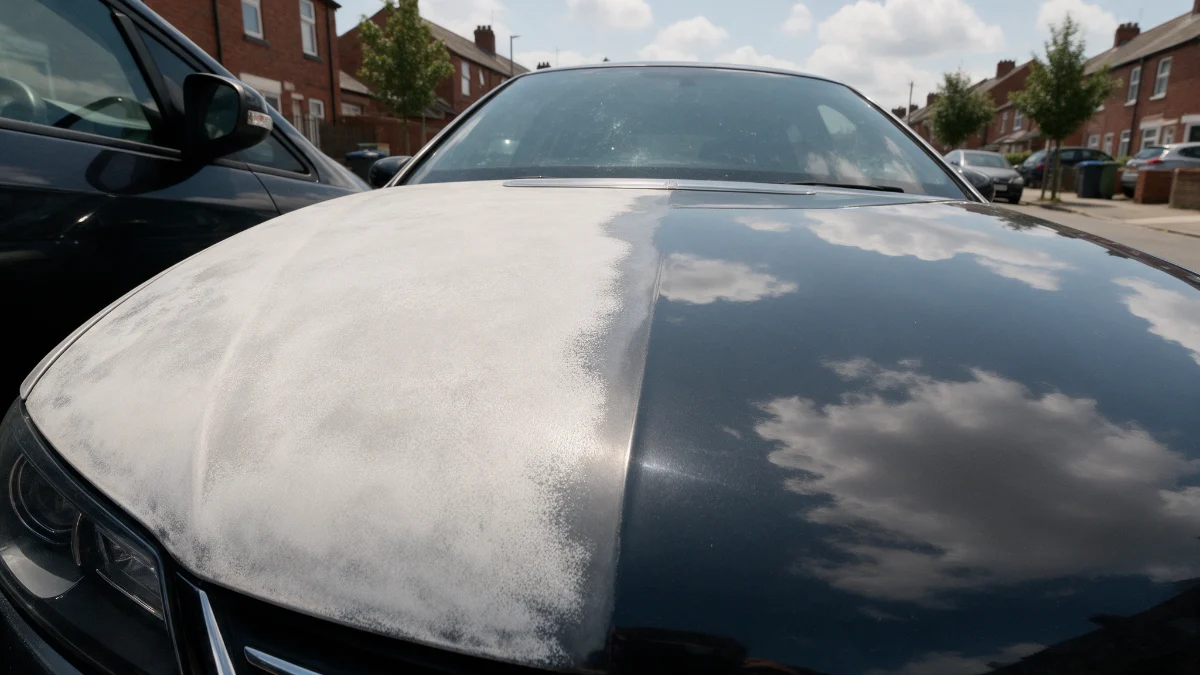
New paint matches when the paint code, the spray technique and the blend into the neighbouring panels are all handled together, and it fails when any one of the three is skipped. The code alone is not enough. A car that has stood outside in Cardiff for eight years has a bonnet that has lost pigment to UV and a sill that has not, so factory-code paint sprayed straight onto your tired panel can look newer than the car around it.
Blending is what closes that gap. Rather than stopping the colour at the panel edge, the spray is carried a short way into the adjacent panel and faded out, so your eye never finds a boundary. On a metallic or a pearl, blending is not optional. Those finishes contain flake that lies differently depending on how it was sprayed, and two technically identical panels can read as different colours from across a car park.
Solid colours are more forgiving on flake and less forgiving on depth, because any variation in the number of coats shows as a patch. White is the hardest of all to blend badly and get away with. A match is a skill rather than a setting, which is why you should see a shop’s work in person before you hand over your keys. The difference between reshaping a panel and fitting a new one is covered in panel beating against panel replacement.
Do you need a full respray or a single panel
A single panel repair is right when the damage is contained and the rest of the paint is sound, and a full respray is right when the finish has failed across the car. Most jobs are the first. A kerbed bumper, a keyed door, a deep scrape along one wing, a stone-chipped bonnet: each is a local problem with a local answer, and respraying your whole car to fix one panel wastes your money.
The picture changes when the failure is general. Lacquer peeling on the roof and both wings, oxidised paint that has gone chalky to the touch, or a car that has already been resprayed badly and is now flaking in sheets, those are whole-car problems. Patch repairs on a car in that state fail at the join, because you are bonding new paint to a layer that is already letting go.
A three-panel repair is the middle route most people forget. Spraying three adjacent panels, rather than one or all fifteen, often gives the best result for the money on a car where damage runs along one side. Ali will tell you which of the three your car needs after the strip down, not before, because what sits under your paint changes the answer, and that is also when you get your quote. The wider repair process for damaged cars is on accident and crash repair in Cardiff.
How long does a paint repair take
A single panel takes two to five days and a full respray takes one to two weeks, with preparation accounting for most of that time in both cases. The spraying itself is measured in hours. Everything around it is not, which is why your car is with us for days rather than hours.
Each stage needs to cure before the next can start, and you cannot hurry curing with a heater and good intentions. Paint that is forced dries hard on the surface while solvent is still trapped underneath, and that is what produces the cracking and the dieback you find on a repair that looked perfect when you collected it. Your car also has to be masked, and on a modern car with parking sensors, badges, trim clips and a bonded windscreen that is a slow job when it is done properly.
Two things stretch a timeline. Parts, if a panel has to be replaced before it can be painted, and discovery, if the strip down reveals corrosion or a previous repair hiding under filler. Both are worth your waiting for. Timelines for the full range of repairs are set out in how long an accident repair takes.
What makes one paint job cost more than another
Paint cost is driven by preparation hours, the number of panels involved, the type of finish and what the strip down finds, not by the litre price of the paint. A plain solid colour on a flat door sits at the cheap end of any quote. A three-stage pearl on a car with damage running across two panels and a sensor-laden bumper is the expensive end, and the paint in the tin is a small part of what you pay.
Four things move your number. How much filling and flatting the panel needs before it is ready. Whether the colour is solid, metallic or pearl, because each extra stage is another pass and another cure. How many panels have to be blended into, which is usually one or two more than the panel you brought in. And whether anything has to come off the car first, since your bumper, lamps, handles and trim all take time out and time back on.
Corrosion is the one that changes a quote after it has been given. Paint over rust and you are hiding it, not repairing it, so if your strip down finds metal that has gone, we cut it out and treat it before anything is sprayed. You get a written quote once your car has been opened up, because a figure given down the phone to a photograph is a figure nobody can stand behind. The full set of cost drivers is explained on what drives a bodywork repair price.
Why paint fails, and what stops it
Paint fails for three reasons: contamination under the finish, a cure that was rushed, and a surface that was never properly keyed. Each one leaves a signature you can learn to read on your own car.
Contamination shows as nibs, small raised specks trapped under the lacquer, or as fisheyes where silicone or grease stopped the paint wetting out. That is a booth and a cleanliness problem. A rushed cure shows as cracking, as a finish that stays slightly soft, or as dieback, where the gloss sinks back over the following weeks and the repair goes dull against the rest of the car. A surface that was not keyed shows as peeling, usually starting at an edge and lifting in a sheet once water gets behind it.
None of those are bad luck, and none of them are your fault as the customer. They are the visible result of time that was not spent. It is also why the right to pick your own repairer matters: the driver chooses the repairer, not the insurer, and a shop working to your insurer’s turnaround target is a shop under pressure to cut exactly these corners. That right, and how to use it, is set out in choosing your own body shop.

Can you respray a classic car or change the colour
Yes to both, and the two jobs are run differently. A classic refinish is about matching a period finish and protecting what is left of the original metal. A colour change is about covering every surface the eye can reach, which is a much bigger job than it sounds.
On a classic, the paint is often the least of it. Older cars carry decades of filler, patch repairs and surface rust, and the honest work is in deciding what to cut out and what to keep. Spray over soft metal and you buy yourself two good summers. The welding side of that work is handled in-house, which is useful on cars where a sill or an arch has to be fabricated rather than ordered.
On a colour change, the cost sits in the parts you do not see from the pavement: door shuts, the inside of the boot lid, under the bonnet, the apertures. Leave those and your car gives itself away every time you open a door, and a buyer will spot it. Tell the DVLA when your car changes colour, because your V5C has to match the vehicle on your driveway. The wider workshop capability is listed on our services.
Does a respray affect insurance or resale
A properly documented respray does not harm a car and an undocumented one does, because a buyer looking at your car cannot tell a quality repair from a cover-up without paperwork. Keep the invoice, keep the paint code, and keep any photographs of the car stripped down. That folder is what turns an awkward question on a forecourt into an answer you can hand over.
Insurers care about two things. You have to declare a colour change, since your car no longer matches its record. And a repair carried out after a claim will usually sit on the vehicle history whether you like it or not, which is a reason to have your repair done well rather than a reason to hide it. A car with a clean, matched, documented repair sells. A car with a mismatched wing and no history sits on your drive.
The route your claim takes decides who pays and how fast you get your car back, when the paint work follows an accident. That process, and what an insurer will and will not authorise, is set out on insurance claim repairs.
Book a paint repair in Cardiff
We are at Unit 4 Wentloog Buildings, Wentloog Road, Rumney, Cardiff CF3 1TH, Monday to Saturday, 9am to 6pm, with six work bays and the spray booth on site. Send us photographs of your panel in daylight and we will tell you whether you are looking at a blend, a single panel or a bigger job, then book your car in. Drivers come to us from across Cardiff and the surrounding towns.
Paint and spray questions we get asked
Can you match paint without the paint code?
Yes, by reading the existing paint with a spectrophotometer and spraying test cards until one disappears against the panel. It takes longer than reading the code off the plate, so find your code first if you can. It is usually on a sticker in the door shut, under the bonnet or in the boot.
Why does my repaired panel look slightly different in the sun?
Because the colour was laid in without blending into the neighbouring panels, or because the surrounding paint has faded and the new paint has not. Both are fixable. Blending into your adjacent panel is the usual answer, and you should not be charged twice for it.
How long before I can wash or polish the car?
Leave it a fortnight before washing with anything stronger than water and a soft mitt, and leave polish and wax alone for around six weeks. Your paint is still releasing solvent, and sealing it in too early is what causes dieback.
Can a scratch be polished out instead of sprayed?
A scratch polishes out when your fingernail does not catch in it, because the damage sits in the lacquer rather than the colour. Once the nail catches, the scratch has gone through to the base coat or the primer and it needs paint.
Do you spray plastic bumpers and metal panels differently?
Yes. Plastic flexes, so it needs an adhesion promoter and a flex additive in the paint, otherwise the finish cracks the first time the bumper takes a knock. Your bumper sprayed like a wing will not last the winter.
Is a mobile spray repair as good as a booth repair?
For a small chip or a scrape on your door it can be fine. For anything larger it is not, because nobody controls dust, temperature or airflow on your driveway, and those three decide whether the lacquer stays clear.
Photograph the panel in daylight, find the paint code in the door shut, and bring the car in for a written quote after the strip down. Call 07400 454839 or use the contact form.