
Early rust shows as a dull brown stain or a line of small blisters under the paint, usually along a sill, an arch lip or a door bottom, and it is always wider underneath than the mark you can see. Most drivers find it in November, washing salt off a car that has sat outside all week. The mark looks small enough to leave until the MOT, which is where the money goes. This guide covers what each stage of rust looks like, the order to check your own car in, and what to do in the week you find it.
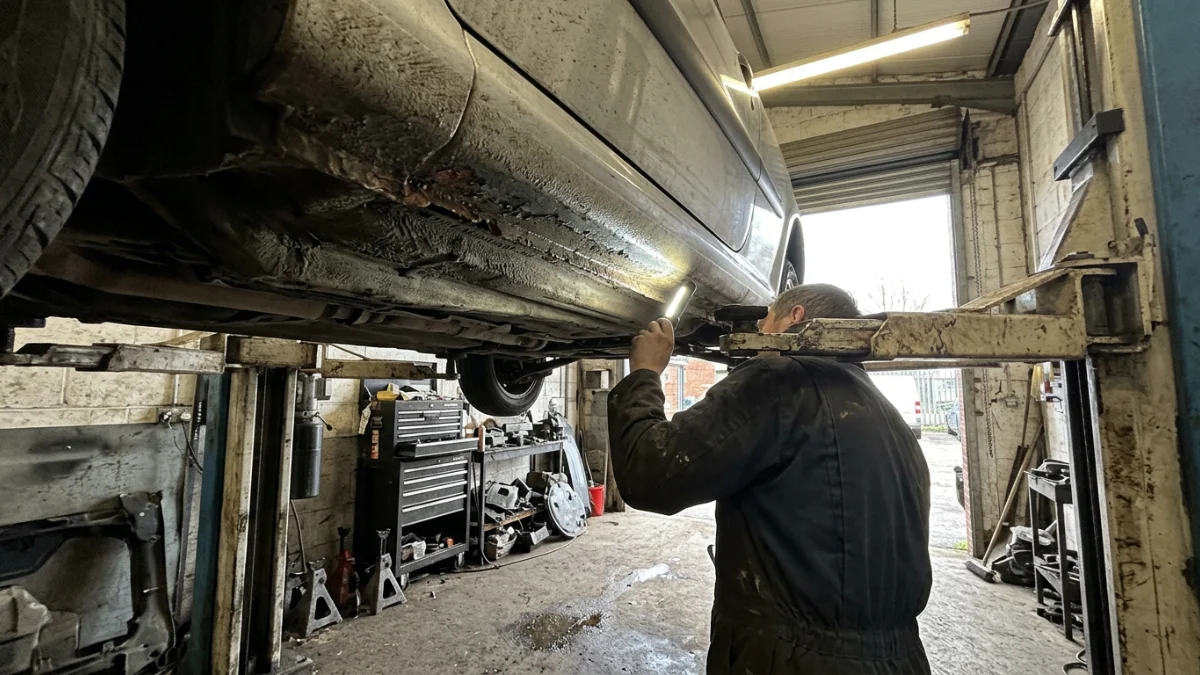
What early car rust looks like
Rust arrives in three stages, and the difference is depth rather than width. Surface rust sits on top of sound metal. Scale has eaten in and lifts off in layers. Perforation is a hole where the metal used to be.
Surface rust is an orange brown film on bare steel at a stone chip, a scratch or an unsealed seam. The metal under it is full thickness. Wipe it and the colour comes away on the cloth, leaving a stain.
Scale is darker and lifts in plates rather than powder. The metal under it is thinner than the metal beside it. A knuckle tapped on scale gives a dead note instead of a ring. Scale on an outer sill has usually come through from the inside.
Perforation is the end of the process. The steel has gone, and the edges of the hole crumble under a thumb. Press a perforated sill and it moves. Nothing can be painted over perforation.
| Stage | What you see | What you feel |
|---|---|---|
| Surface rust | Orange brown film at a chip or a seam | Slightly rough, flat to the panel |
| Scale | Dark brown to black, lifting in plates | Crusty and raised, dead note when tapped |
| Perforation | A hole with soft crumbling edges | Moves under a thumb, edges break away |
Stage decides what the repair involves. Position decides whether it is paint work or welding.
Where rust starts on a car, and the order to check
Check a car from underneath first, then work round it at eye level. Rust starts where water sits and air cannot reach, which is everywhere a weekly wash misses.
Start with the sills. Look along the outer sill, then crouch and look at the seam where it folds under to meet the inner sill. That seam holds water and road dirt against itself all winter. Open the door and look at the same sill from the door shut, because an inner sill rots from the cabin side where damp carpet keeps it wet.
Then work round the car in a fixed order. Each of the seven stops below has a reason.
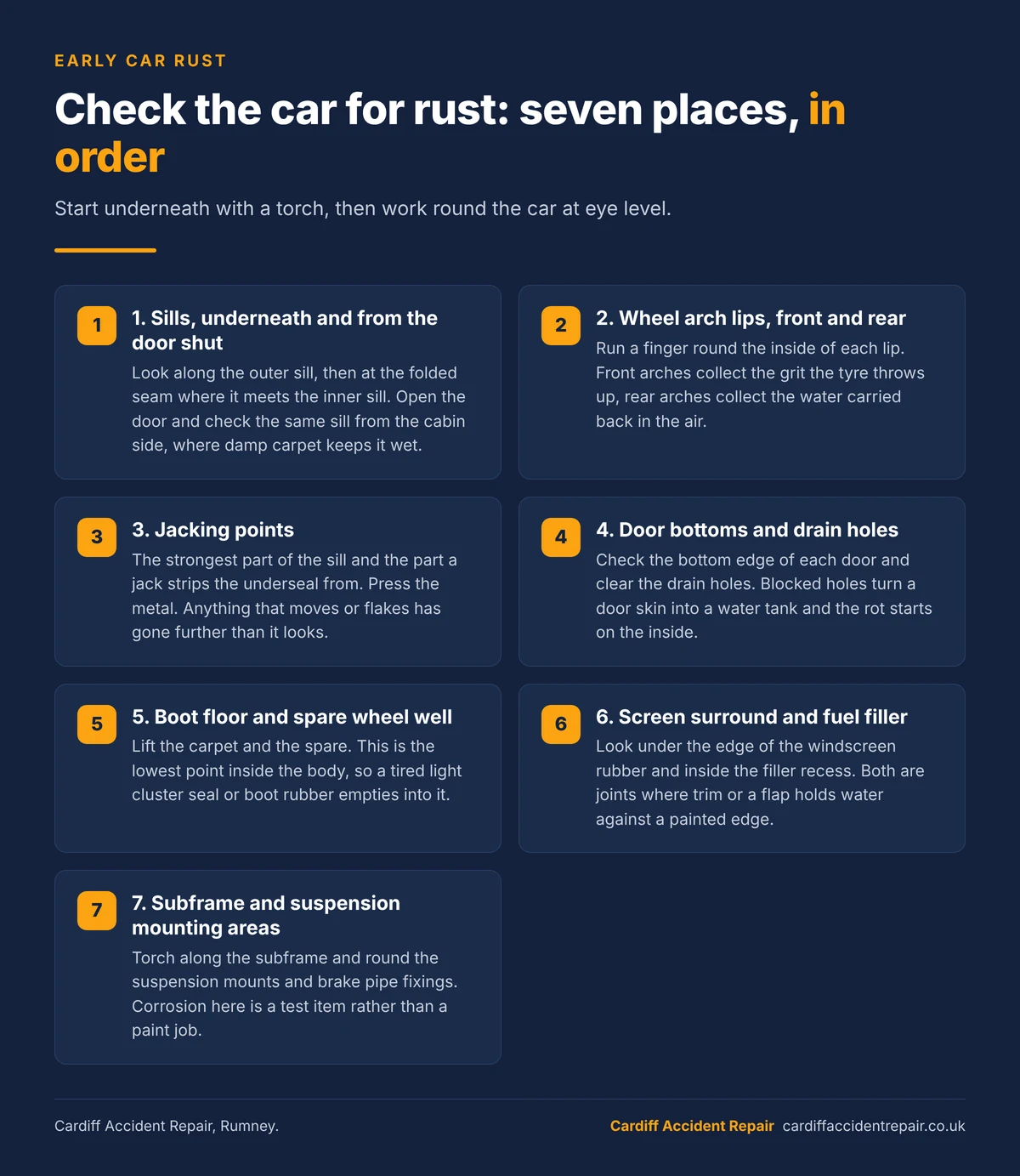
- 1. Sills. The folded outer to inner seam, then the sill from the door shut.
- 2. Arch lips, front and rear. A finger round the inside of each lip.
- 3. Jacking points. Press the metal. Anything that moves has gone further than it looks.
- 4. Door bottoms and drain holes. Blocked holes turn a door skin into a tank.
- 5. Boot floor and spare wheel well. The lowest point inside the body.
- 6. Screen surround and fuel filler. Trim and flaps hold water on a painted edge.
- 7. Subframe and suspension mounts. Torch the mounts and brake pipe fixings.
Most of those stops give the same first sign, and it is a blister in the paint.
What does a bubble under the paint mean?
A bubble under paint means the metal beneath it has already corroded and the rust has lifted the paint off the surface from behind. The blister is the roof of a cavity, so the corroded area is always larger than the mark you can see.
Iron oxide takes up more room than the steel it replaces, so the corroding metal swells and pushes the paint film off the panel. Water reached it through a chip or an unsealed seam and has worked outwards ever since.
Press a blister with a thumbnail. A soft crackle means the paint has lost its grip and there is loose scale under it. Paint that stays firm is lifting at the edge of a chip rather than over a cavity, which is a smaller job.
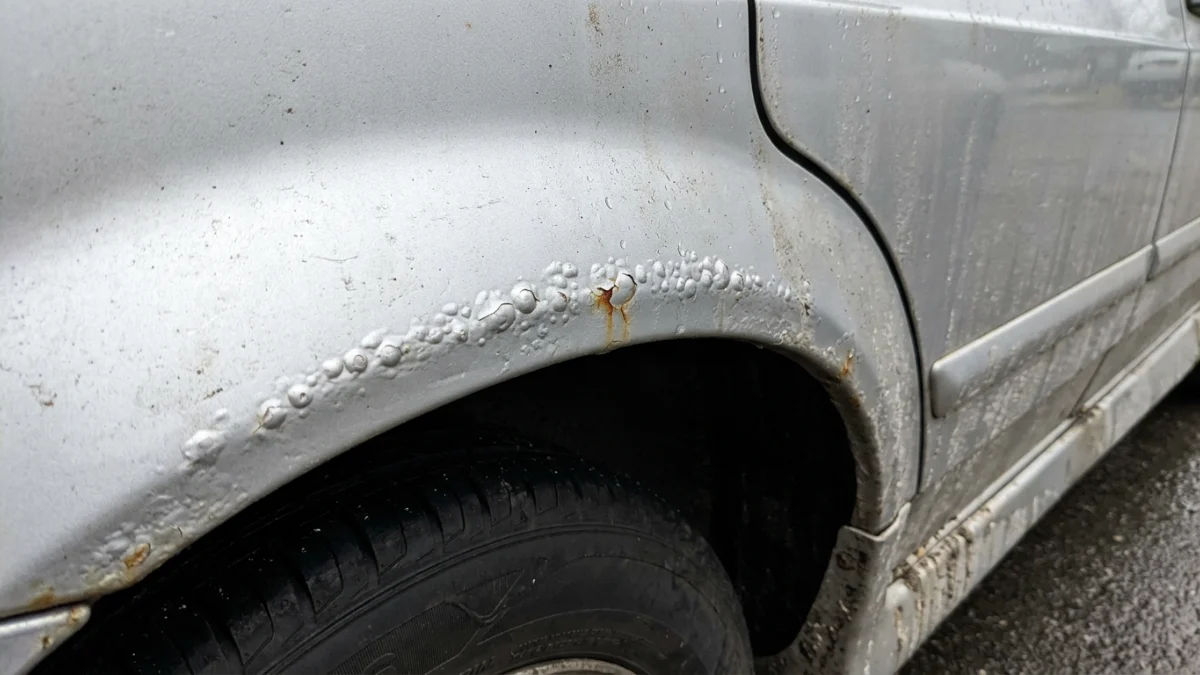
This is why no firm figure comes out of a photograph. The paint and the underseal come off, the sound edge is found, and only then is the size of the repair known. The damage is assessed on the car at strip down, and the quote follows the assessment. How a corroded panel is refinished is on the bodywork repair page.
Found a blister on a sill or an arch
Send a photograph of the blister and the panel it sits on, and we will say whether it is paint work or metal work. Rumney, Cardiff CF3 1TH, Monday to Saturday, 9am to 6pm.
Why a magnet and a torch tell you more than a photograph
A magnet and a torch answer the two questions a photograph cannot: how thick the metal still is, and whether somebody has been here before.
The magnet. A small magnet holds firmly on sound steel. Over filler or body paste it holds weakly or slides off, which marks out a previous repair. Work it along a sill and the weak spots appear in a pattern. Aluminium panels are not magnetic, so on an aluminium bonnet a magnet tells you nothing.
The torch. Light raking along a sill at a shallow angle shows the ripple and pinholes flat daylight hides. A torch also gets inside, through a jacking point slot, a drain hole or the gap behind an arch liner.
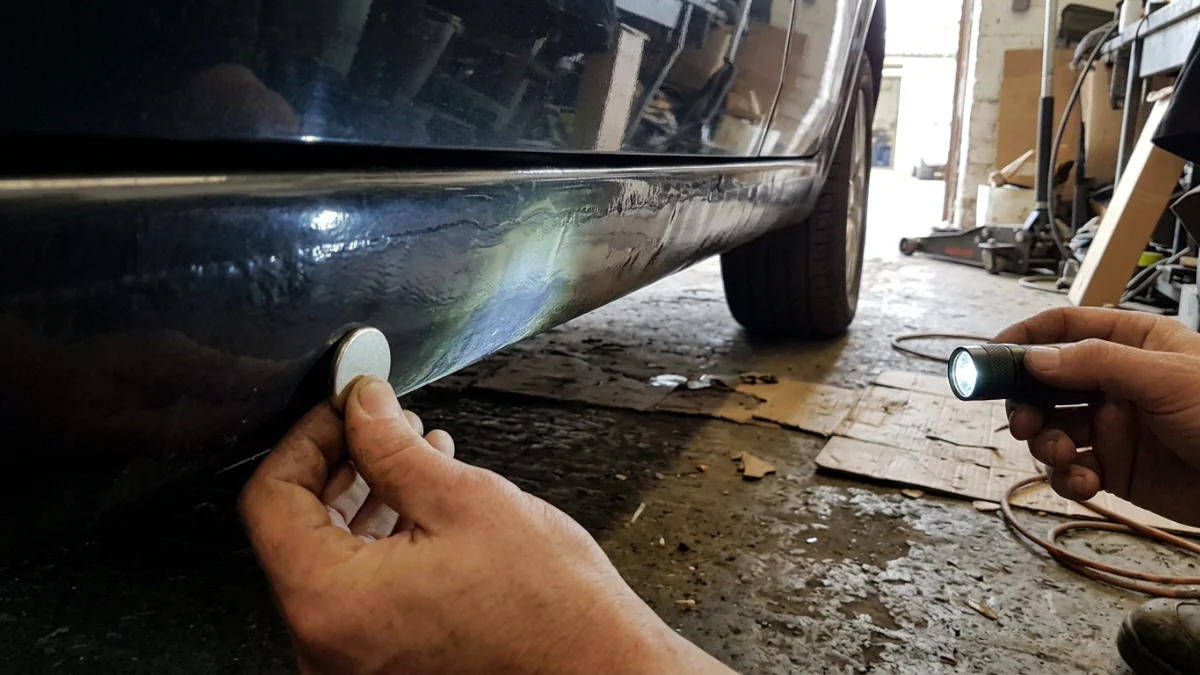
A photograph flattens that. Rust photographs as a stain, and a stain looks the same whether the metal behind it is full thickness or paper. Photographs still tell us which panel and seam to look at first, and how to photograph car damage for a quote covers the angles that survive a messaging app.
Which rust is cosmetic and which becomes an MOT problem
Rust divides into two kinds, and the division is position rather than appearance. Corrosion on an outer skin is paint and panel work. Corrosion on or near anything carrying a load, a fixing or a brake pipe is a test item, and the DVSA MOT inspection manual judges it within 30cm of those mounting points.
Rust that is paint and panel work
Arch lips, door skins below the trim line, boot lid edges, the screen surround and the fuel filler recess are outer skin. Corrosion there does not fail a test on its own. It spreads, and it turns a local repair into a whole panel if it is left.
Rust that becomes a test failure
Sills, floor pans, jacking points, inner wings, seat belt anchorages, suspension mounting areas, subframes and brake pipe fixings are structural or safety related. Corrosion that has significantly weakened them is a failure, and a tester may probe anything suspect. That shades into the territory chassis damage after an accident sets out.
Both kinds get worse at the same time of year, and for the same reason.
Road salt on the A48, the M4 and Newport Road
Road salt is why a Cardiff car that was sound in September has a blister by February. Salt lowers the freezing point of water, and the solution it makes is an electrolyte. Bare metal in salt solution corrodes far faster than bare metal in rain water.
Cardiff Council grits its priority routes through the winter, and in east Cardiff those are the roads everybody uses: the A48, the roads feeding the M4 at Cardiff Gate, and Newport Road through Rumney and Llanrumney. Traffic turns grit into spray, and the spray goes into the arches, along the sills and into every seam underneath. Grit also chips paint on the lower doors and arch edges.
A car parked outside never dries out between gritting runs. Overnight damp wets a salted sill again, so the metal spends the winter wet with solution rather than water. A car on a street in Rumney, Trowbridge or St Mellons never gets the chance to dry.
The advice is short. Hose the underside and each arch liner after a run on salted roads and let the car dry. Clear the drain holes with a cable tie. Look at the sills before the MOT rather than after, because a blister caught while the metal is still sound is paint work, and the same blister left to perforate is a welded repair. The same salt lifts the lacquer on alloy wheels, covered under alloy wheel refurbishment, and the towns we cover are on the areas we cover page.
What to do in the week you find rust
Finding rust is not an emergency, and it is not something to sit on. Five things are worth doing in the week you find it.
- Wash and dry the area. Road film hides the edge of the corrosion, and a dry panel shows the true colour.
- Press it. Thumbnail on the blister, thumb on the sill. Metal that crackles or moves has gone further than the mark suggests.
- Photograph it in daylight. One square to the panel, one from underneath, one from a few paces back.
- Check the matching place on the other side. Rust is close to symmetrical, because both sides collected the same salt.
- Get it looked at before the MOT. A blister assessed in November is a booking. Found by a tester, it is a failure and a retest.
The welding and sealing side of it is described on the rust and sill repair page.
How a rust and sill repair is actually done
A rust repair is a sequence, and skipping part of it is why some repairs come back within a winter. Corroded metal is cut out rather than filled over, because filler laid over scale lifts as the metal under it keeps moving.
The area is stripped to bare metal and the sound edge is found. Corroded metal is cut back past that edge. A repair panel is cut to fit, or a pressed repair section used where one exists, and it is MIG welded in with the welds dressed level. Structural work is measured before welding, so the panel gaps and shut lines come back where the factory put them.
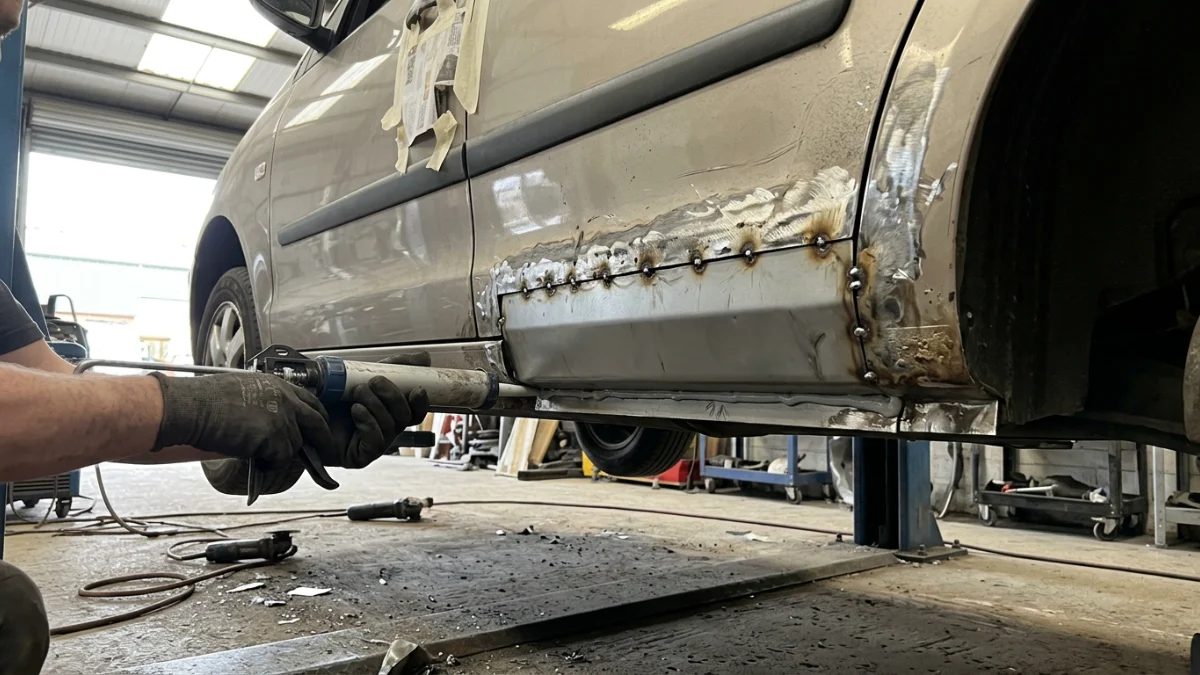
Then the protection goes back in order: weld through primer where panels overlap, etch primer on bare metal, seam sealer along every factory joint, cavity wax inside the sill and underseal outside. Paint follows: base coat mixed to the colour code, lacquer, blending into the next panel, then flatting, compounding and a machine polish. Saving a panel or renewing it follows the same logic as panel beating against panel replacement, and the refinishing is on paint and spray repairs.
What changes if it is left until next winter
Rust does not pause. Each winter moves it one stage on, and each stage turns one trade into two.
| Found at this stage | What the work involves | What it becomes if it is left |
|---|---|---|
| Surface rust on an arch lip | Strip to bare metal, treat, prime, refinish | Blistering along the lip, then a repair section |
| Blisters along a sill seam | Cut back to sound metal, let in a piece, reseal | A full outer sill section, welded and sealed |
| Scale at a jacking point | Cut out, repair panel, weld, seal, underseal | Perforation at a structural point, and a failure |
| Corrosion round a suspension mount | Plate or renew the mounting area, measured | Welding plus suspension work, longer off road |
No prices are published on this site, for the reason above: the extent is found on the car with the paint off. What changes the figure on a bodywork job is on what moves a bodywork repair price.
Getting rust looked at in Cardiff
Bring the car to the Rumney workshop and it goes on the ramp. The sills are checked from underneath, from each door shut and from inside with a torch, and the jacking points and mounting areas are probed rather than looked at. You are told which stage you are dealing with before anything is booked.
Ali Hindal does the assessment and the welding himself at Unit 4 Wentloog Buildings, where the six work bays sit alongside the on site spray booth. The same strip down before quoting applies to collision work on the accident repair in Cardiff page.
Get the sills checked before the MOT, not after
A rust check on the ramp tells you whether this winter is paint work or welding. Rumney, Cardiff CF3 1TH, Monday to Saturday, 9am to 6pm.
Questions about early car rust
Can surface rust be stopped without bodywork?
Surface rust on sound metal can be stopped. The area is taken back to bare steel, treated, primed and refinished, and the chip or seam that let the water in is sealed. Scale cannot be stopped by treatment, because it is already working from behind the panel.
Is a bubble in the paint an MOT failure?
A bubble on an outer skin is not a failure on its own. The same bubble on a sill, a floor pan, a jacking point or near a brake fixing is different, because the DVSA MOT inspection manual judges corrosion there on whether structural strength has been significantly reduced.
Does underseal stop rust?
Underseal keeps water off clean, sound metal. Sprayed over existing rust it seals the moisture in and hides the spread, so the panel rots on under a black coating that looks reassuring. Underseal belongs on metal already cleaned, treated and primed.
Can a rusty sill be repaired, or does it need a whole new panel?
A sill is usually repaired with a let in section rather than renewed entirely. The corroded part is cut out, a repair piece welded in, and the seams and cavity sealed again. A full outer sill section goes on when the corrosion runs most of the length.
Will washing the car in winter make the rust worse?
Washing reduces the risk rather than adding to it, provided the car dries afterwards. Salt left on the underside keeps metal wet with an electrolyte for weeks. Rinsing the arches, sills and underside after gritted roads removes it, and clear drain holes let the rest run out.
Why is the rust bigger once the paint comes off?
Paint hides the edge of the corrosion, because rust spreads between the metal and the paint film before it breaks through. The blister marks where the paint lifted, not where the metal first went. Stripping back to the sound edge is the only way to find the real size.
Send photographs of the sills and arches, or bring the car to Rumney and we will put it on the ramp and tell you which stage you are at. Unit 4, Wentloog Buildings, Wentloog Road, Rumney, Cardiff CF3 1TH, Monday to Saturday, 9am to 6pm. Call 07400 454839 or use the contact form.