
A car scratch that your fingernail glides over sits in the lacquer alone and will polish out, and one your nail catches in has gone through the colour, which means paint rather than polish. You are looking at a pale line down your door in a dark car park, wondering whether a bottle of compound will deal with it. Nobody wants to pay for paint on a mark that would have buffed out, and nobody wants to leave bare steel open to a salted Cardiff winter. The depth decides which of those you are facing, and your own hand reads it in under a minute.
What the paint on your car is made of
Factory paint is a stack of thin layers, and a scratch is classified by how many of them it has broken. Working outwards from the steel: a protective coat, a primer for the colour to key to, the base coat that carries the colour, and a clear lacquer over the top.
The lacquer is the part that shines. Base coat has almost no gloss of its own, so every reflection down the side of your car comes from the clear layer above it. A mark can dull a panel without touching the colour.
Primer is grey, white or black, depending on the colour over it. A deep scratch on a red car reads as a pale line rather than a red one, which is why people assume it has gone to metal.
Depth decides the method. Lacquer damage can be levelled, because sound lacquer sits underneath it. Once the colour is cut through there is nothing left to flatten back.
How do I tell how deep a car scratch is?
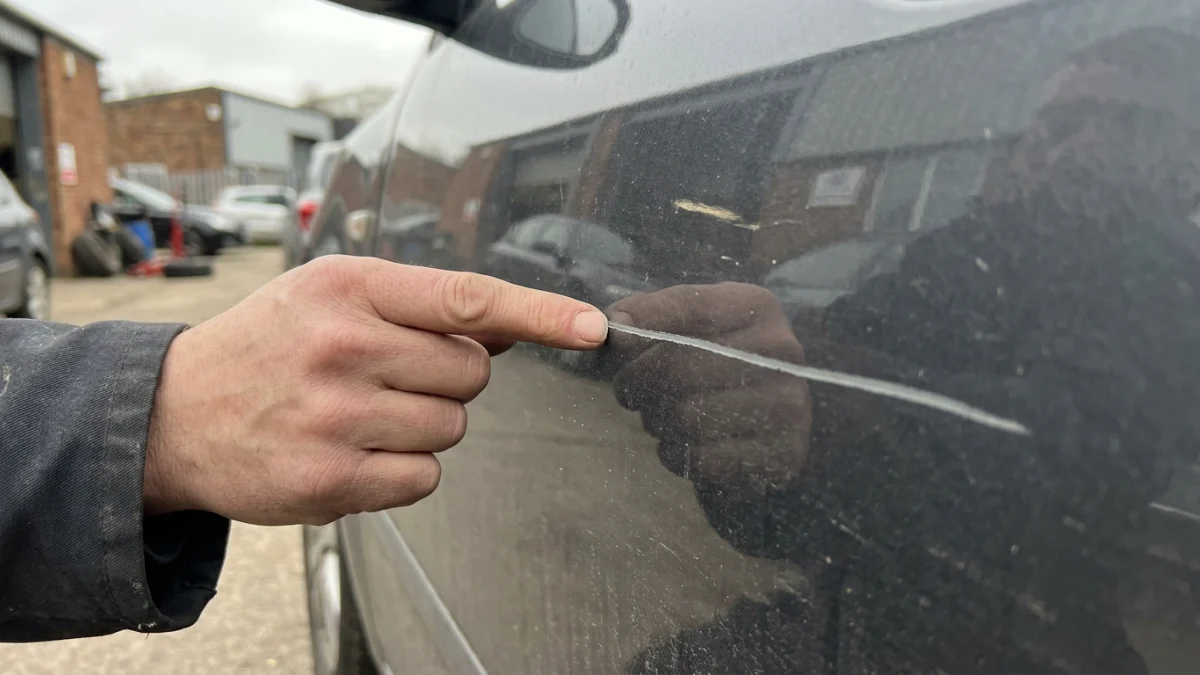
Your fingernail reads the depth. Draw a nail lightly across the scratch at a right angle to it: a nail that passes over with no catch means the damage is in the lacquer, and a nail that drops into the groove means the scratch has gone through the colour.
False readings come from one of these.
- Dry the panel first. Water fills the groove, so a wet scratch feels shallower and looks fainter than it is. A car straight out of the rain hides its own damage.
- Get the light across the panel, not at it. Under a streetlamp on a wet November afternoon almost nothing shows, which is why the mark looks worse the next morning.
- Draw the nail across it, not along it. Light pressure, square to the line. Along the groove it rides the raised edges.
- Test the whole length. A trolley mark is rarely one depth. It begins in lacquer and deepens where the object dug in.
The nail gives you a depth, and that depth is four different jobs. Depth is the thing photographs most often lose, which is covered in how to photograph car damage for a quote.
The four depths, and what each one needs
Every scratch sits on one of four rungs, and the rung gives you the method.
- Lacquer only. The nail passes over and the mark often disappears while the panel is wet. Compounding and a machine polish level the lacquer flat and the gloss returns.
- Through to base coat. The nail just catches, and the line stays visible on a wet panel with the colour in the groove dulled. Colour has to go back: touching in and flatting, or a blow in where the mark is long.
- Through to primer. The nail drops in and the groove reads grey, white or black. The area is prepared, primed, given base coat, lacquered and blended out, because new colour meeting old at a hard edge shows.
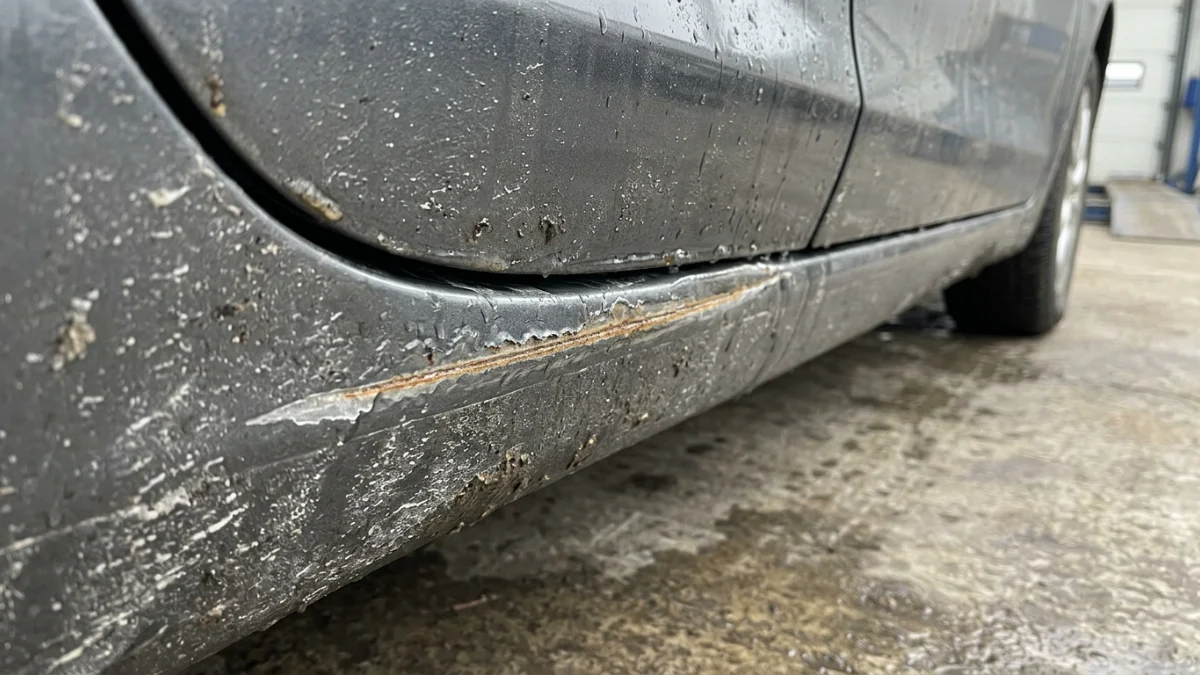
- Through to bare metal. The nail catches hard and the line is bright silver, or brown once wet. This one is a clock, not a cosmetic problem.
| Depth | The fingernail | What you see | What the panel needs |
|---|---|---|---|
| Lacquer only | Passes over, no catch | Fades or vanishes when wet | Compound and machine polish |
| Into base coat | Just catches | Line stays when wet, colour dulled | Touch in and flat, or blow in the panel |
| Through to primer | Drops into the groove | Grey, white or black line | Prep, prime, base, lacquer, blend |
| Through to metal | Catches hard | Bright silver, or brown once wet | Treat the metal, etch prime, paint, seal |
Two cases sit outside it. A panel pushed in as well as marked needs the metal decision first, set out under panel beating or panel replacement. A scratch crossing two panels is separate paintwork on each, which moves a figure further than the length of the line, as the bodywork repair prices page explains.
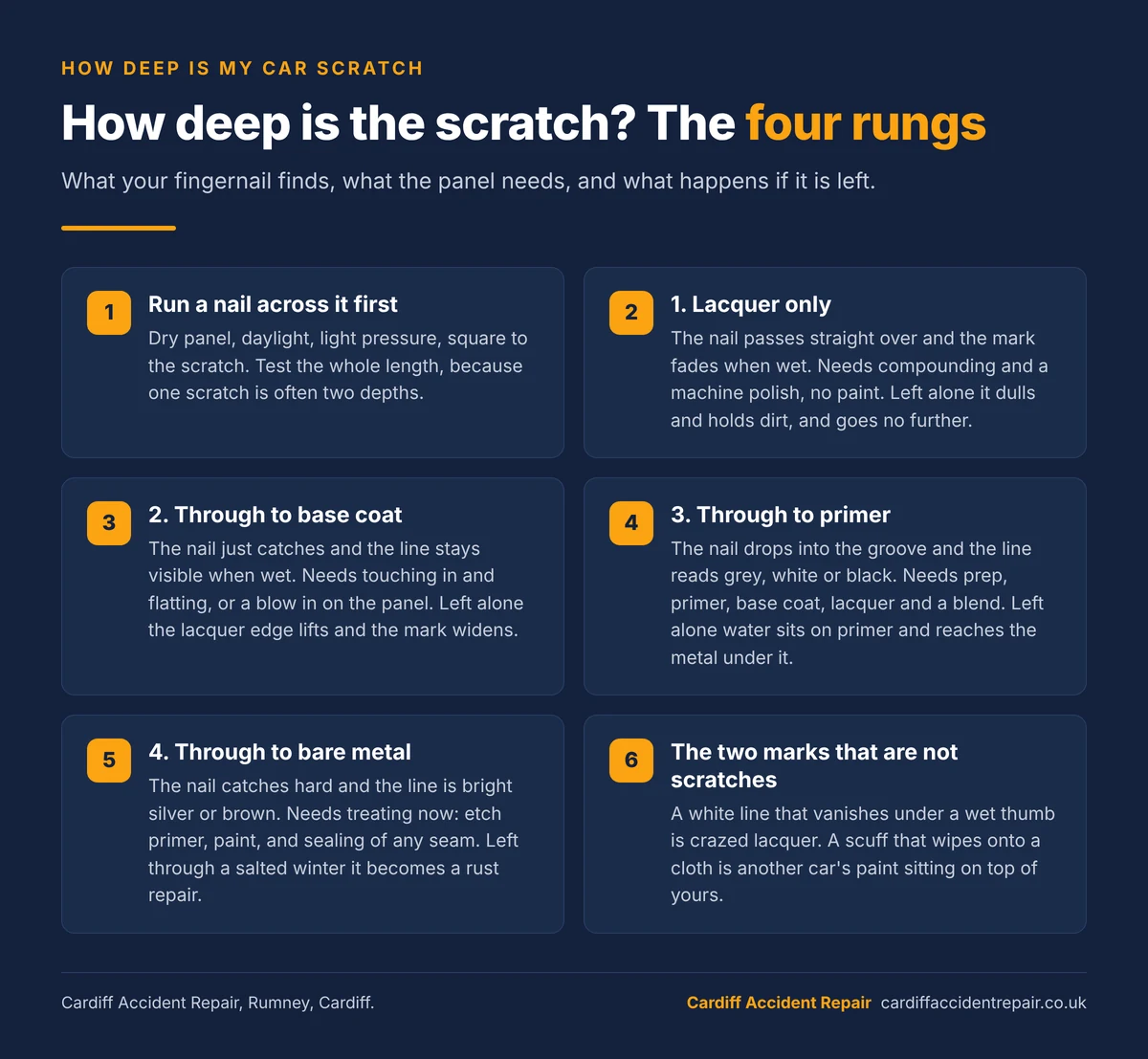
- Rung one, lacquer only. Nail passes over. Compound and polish. Left alone it dulls and holds dirt.
- Rung two, into base coat. Nail just catches. Colour goes back. Left alone the lacquer edge lifts and the mark widens.
- Rung three, through to primer. Nail drops in. Prep, primer, base coat, lacquer, blend. Left alone water reaches the steel beneath.
- Rung four, bare metal. Nail catches hard. Treat it now. Left through a salted winter it becomes a rust repair.
Can a scratch be polished out?
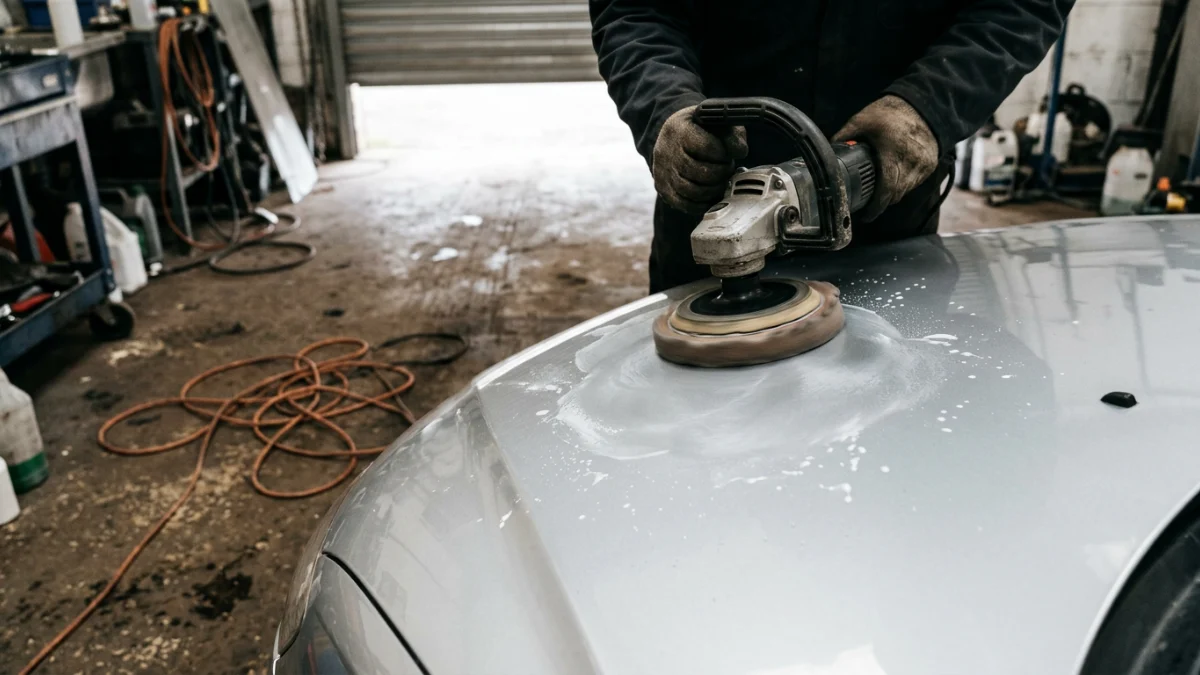
A scratch polishes out when it sits inside the lacquer and not through it. Machine polishing cuts a fine layer of lacquer away with an abrasive compound, so it levels any mark shallower than the lacquer left on the panel, and nothing deeper.
Compounding is the coarse stage and polishing the fine one. A machine with the right pad takes the high edges down until the surface is level, then a finer polish brings the gloss back. The same compound by hand tends to dull the paint and leave the scratch where it was.
Lacquer is finite, so a panel machined several times has less left, and polishing through lacquer turns a cosmetic job into a refinish. The depth is read on the panel before anyone commits, and the quote follows that reading. The work is on the dent and scratch repair page.
Not sure whether yours will polish out?
Send a photograph with the light across the mark and we will tell you which depth it is. Unit 4, Wentloog Buildings, Wentloog Road, Rumney, Cardiff CF3 1TH. Monday to Saturday, 9am to 6pm.
Why a scratch that has gone white is not always deep
A white line is usually broken lacquer rather than missing colour. Something dragging across clear lacquer crazes it into tiny fractures, and those fractures scatter light instead of passing it through, so the eye reads white although the base coat underneath is untouched.
This is the most common false alarm we see. White marks on a dark car look dramatic and often polish out. White marks on a white car look mild and are sometimes down to primer.
A wet thumb settles it. Wipe along the mark: water fills the crazed lacquer, so the mark very nearly disappears while wet and returns as the panel dries. That means polish will work. A line that stays exactly as visible when wet has lost colour, and colour has to be sprayed back on. Some marks are not cut into your paint at all, which is the next thing to rule out.
What a scuff is, and why it is often not your paint
A scuff is material transferred onto your panel from whatever touched it, sitting on top of your lacquer rather than cut into it. Another car’s bumper, a trolley edge, a bollard, a wheelie bin on a windy night: each leaves its own colour behind.
Colour alone usually tells you. A black smear on a white car is not your paint, because paint cannot change colour. Those marks come off with a compound, a clay bar or a tar and glue remover.
Supermarket car parks produce most of them, and dark afternoons most of those: doors opened against the next car, trolleys crossing a sloped bay, a bumper feeling its way into a tight space. Who pays is a separate question, answered in car park damage and who pays. Kerb scuffs on a rim behave the same way and are treated differently from paint, under alloy wheel refurbishment.
What a scratch through to primer needs
Primer in the groove means a paint job, and the sequence is fixed. The area is cleaned and degreased, the edges are feathered back so there is no step for new paint to show, exposed metal is given etch primer, then primer is built over the repair and flatted level.
Colour goes on next, mixed to the colour code on the car rather than the name of the colour. Base coat is laid in light coats across the repair and out into the panel, lacquer goes over and is cured, then the area is polished.
Preparation takes longer than spraying. Paint reveals whatever is underneath it, so a scratch that was not properly feathered shows as a line under the new colour. The same sequence on larger areas is on the bodywork repairs page.
What a bare metal scratch does over a Cardiff winter
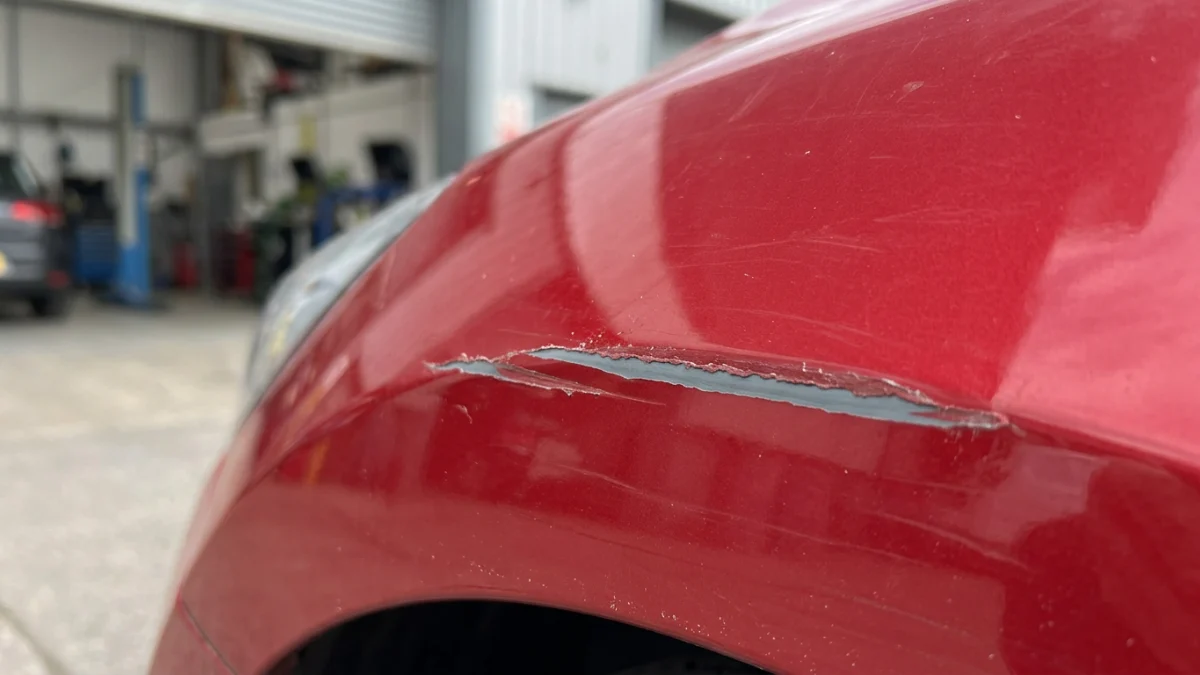
Bare steel corrodes as soon as it is wet, and road salt makes the water a better conductor, speeding the reaction up. A scratch to metal in November is a different problem from the same scratch in June, and the difference is how fast the steel goes.
Rust does not stay in the line. Oxide occupies more room than the steel it came from, so it lifts the paint either side of the scratch from below, and water then reaches fresh metal under that lifted edge. A mark one small repair would have covered becomes an area, and on a lower panel a section. On a sill or an arch lip that is urgent.
East Cardiff gives this every encouragement. Salt and grit go down on the A48 and the M4 whenever a freeze is forecast, and the spray coats the lower half of every car on Newport Road. Add a frost scraped off with a key or a hard blade and there is a fresh cut going into the same winter. What the welded repair involves is on the new rust and sill repair page.
The urgency is about moisture reaching steel, not appearance. Cover the metal and the clock stops. Where the repair then has to reach into the next panel is a question of colour, not size.
When a scratch means blending into the next panel
Colour decides this, not the size of the scratch. Paint on a car that has stood outside for years has moved away from the colour it left the factory as, so a panel sprayed to the original code can read brighter than its neighbours. Blending sprays a diminishing amount of colour into the adjacent panel, so the eye never meets a hard line.
Metallics and pearls force the question more often than solid colours. Metallic flake lies at an angle set by how it was sprayed, so two identical mixes can read differently. A colour code also covers more than one variant on many models, which is why a spray out card is compared against the panel first.
A scratch on a door near a shut line is usually blended into the wing or rear quarter. A scratch in the middle of a large panel can often be contained. That judgement is made under the booth lights, and the work is on the paint and spray repairs page.
Getting a scratch read properly in Cardiff
Depth is read on the panel, in good light, with a nail and a thumb, and the quote follows that reading. We do not price a scratch and then find a method to fit the figure. That is how a mark needing colour gets polished and reappears by spring.
The workshop is in Rumney, east Cardiff, in the CF3 postcode, minutes off Newport Road and close to the A48 and the M4. Drivers from Newport, Caerphilly, Barry and Penarth come across for the same work, and routes are on the areas we cover page.
Bring the car, or send photographs with the registration so the exact paint can be identified. Either way you will be told which rung the scratch is on, and what it needs, before committing to anything.
Have the depth confirmed before you buy any polish
A nail test narrows it down and a technician settles it. Ring the Rumney workshop, or send photographs with the registration, and you will have the method before the car moves.
Questions about scratch depth and repair
Will a polish kit remove my scratch?
It will remove a lacquer scratch and will not touch anything deeper. Retail compound is mild, so it takes several passes by hand and dulls dark paint around the mark. On a scratch your nail catches in, the missing colour stays missing.
Does bare metal need doing straight away?
Bare metal needs covering promptly, and more so through a salted winter. The steel corrodes as soon as water sits on it, and the rust lifts the paint either side of the line, which turns a small repair into a larger one.
Can one scratch be repaired without painting the whole door?
Yes, on most scratches. A short mark is repaired and blended within the panel, and a long mark usually means the whole panel is sprayed for an even finish. Where the mark sits, and how the colour behaves, decide it rather than its length.
My nail catches but the line is silver, not grey. Why?
Silver means the metal is exposed. Primer reads grey, white or black and is flat, while bare steel and aluminium are bright in the groove. A silver line is the most urgent of the four depths, because nothing covers the metal.
Do touch up pens work?
A touch up pen puts colour into the groove and keeps the weather off the metal, which is useful on stone chips. It does not level the surface, so the repair sits proud or hollow and catches the light on a visible panel.
Will a repaired area match paint that has faded?
A good match comes from testing rather than from the code alone. The code is a starting point, a spray out card is compared against the panel in the right light, the colour is adjusted, then blended into the next panel. Matched that way a repair is not detectable.
Is a keyed car along several panels priced differently?
Scratch work is assessed panel by panel, so a line from the front wing to the rear door is three pieces of paintwork rather than one long scratch. One wide photograph of that side tells us how many panels are involved.
Run a nail across the mark, then send a photograph and we will tell you which of the four depths you have. The workshop is at Unit 4, Wentloog Buildings, Wentloog Road, Rumney, Cardiff CF3 1TH, open Monday to Saturday, 9am to 6pm. Call 07400 454839 or use the contact form.