
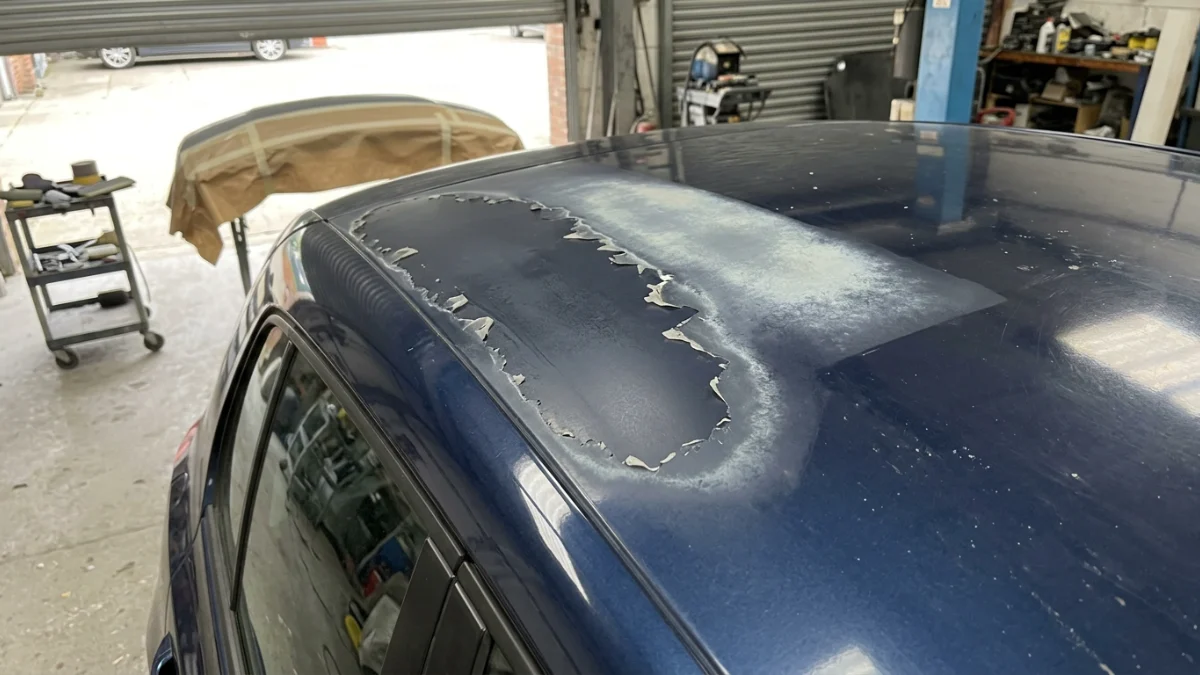
Lacquer peels because the clear coat has either broken down from the top, where sunlight destroys the resin, or lost its grip from underneath, where an earlier repair was laid on poor preparation, and both end with a film that releases in sheets. You are looking at a patch on the roof or the bonnet that has gone milky, with a flake at one side that catches a fingernail. Every polish aimed at it has made it slightly worse. The panel needs flatting back and refinishing, and the only open question is how much of the panel is involved. This guide explains what the clear coat does, why it fails, and what the repair involves.
What is the clear coat on a car
The clear coat, or lacquer, is the unpigmented top layer sprayed over the colour. On a modern car the paint is a stack: electro primer, primer surfacer, base coat carrying the colour, and lacquer over the top.
Three jobs sit with that layer. It holds the ultraviolet absorbers that stop sunlight reaching the pigment. It provides the gloss, because base coat dries matt. And it takes every piece of contact the car gets, because each wash mitt and machine polish works on the lacquer, never the colour. The colour underneath is thin, matt and defenceless.
Why does lacquer peel on a car
Lacquer peels when the bond between the clear coat and the base coat gives way, and that happens from either side. Sunlight destroys the film from above. Contamination or poor flatting under an earlier repair means the bond was never made at all.
Five causes account for nearly all of it, and each leaves its own pattern.
- Ultraviolet breaking down the resin. Sunlight attacks the film from the surface down. The resin loses its flexibility, the surface chalks, and the lacquer lets go.
- A previous repair laid on poor preparation. Lacquer sprayed over a panel that was not flatted, or over polish or silicone residue, never bonds. It releases as one clean sheet.
- Stone chips letting water under the edge. A chip opens the side of the film. Water then works along the boundary with the base coat and lifts it.
- An aggressive polish taking the film thin. Compounding removes lacquer. A panel cut hard carries less ultraviolet absorber, so it fails earlier.
- Bird lime and tree sap left to etch. Both are acidic and concentrate as they dry in sun. They etch a crater, and the crater fails first.
The pattern tells you whether the rest of the car is about to follow. A film aged by sunlight has aged across every horizontal panel, and a sheet with a sharp edge is reporting on work done years ago, as damage that does not show from outside covers. Paint condition is the detail most often misjudged from a photograph, so photographing the damage properly changes the answer you get.
Why peeling starts on the roof, bonnet and boot lid
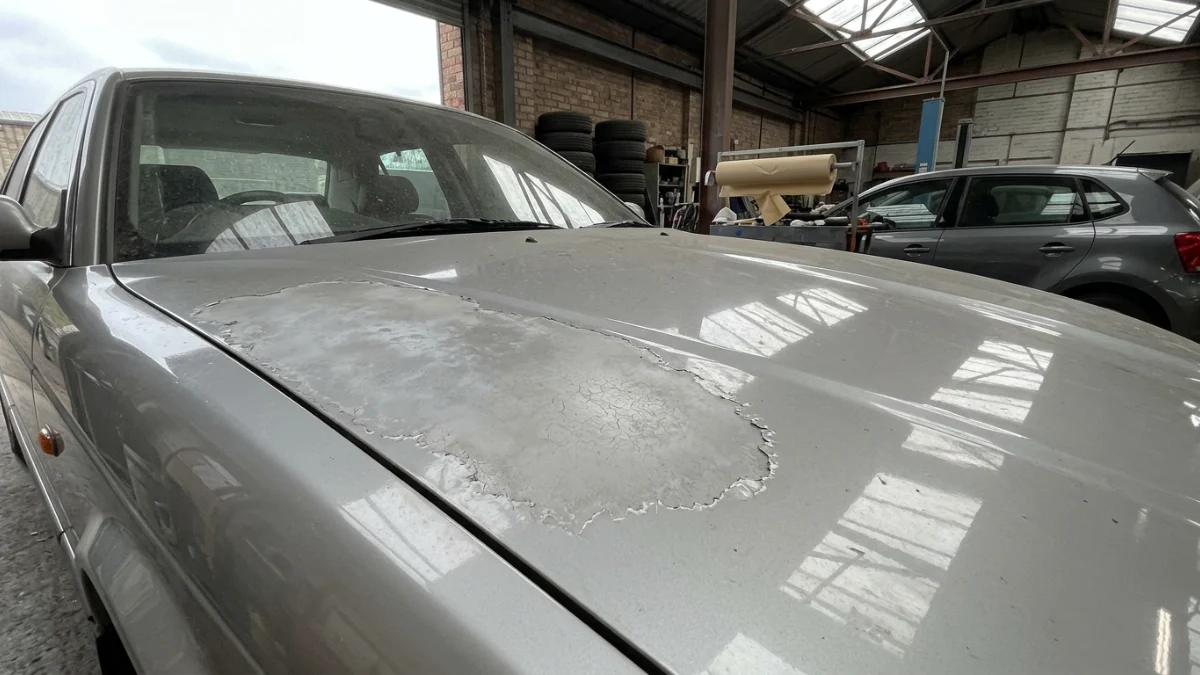
The roof, the bonnet and the boot lid fail first because they face the sky. Sunlight strikes them close to square for most of the day, rain and dew sit on them instead of running off, and bird lime, tree sap and traffic film stay where they land.
A vertical panel has an easier life in all three respects: light reaches a door at a shallow angle, water runs off it, and dirt goes with the next shower. The bonnet also cycles the film up and down in temperature with engine heat.
The cloudy patch that comes before the peel
The cloudy patch is the lacquer breaking up inside itself. Fine cracking and chalking in the resin scatter light instead of reflecting it, so the panel reads milky while the colour underneath is still sound and still firmly attached.
Run a hand across it and it feels rough where the panel beside it feels like glass. Put water on it and the cloudiness vanishes while the panel is wet, because water fills the cracking and lets light through. This is also the one window where the job is at its smallest, because the film is still bonded.
Is a panel on your car starting to go milky?
Send a photograph of the patch, dry and in daylight, and we will tell you whether the lacquer has lifted or is still holding. Unit 4, Wentloog Buildings, Wentloog Road, Rumney, Cardiff CF3 1TH. Monday to Saturday, 9am to 6pm.
Why a peel spreads once it has started
A peel spreads because the failure sits at the boundary between the lacquer and the base coat, and an open edge gives water a route into that boundary. Every wash and every cold night drives the separation further across the panel.
Three forces do the work. Water tracks along the interface and breaks the bond ahead of the visible edge. Jet wash pressure gets under the lifted film and removes in seconds what would have taken months. Trapped water expands as it freezes and prises the edge up. Ageing lacquer shrinks too, so a free edge curls and catches more water.
Can polish fix peeling lacquer
Polish cannot fix peeling lacquer, because polishing works by removing a thin layer of clear coat in order to level the surface, and a peeling panel has no sound clear coat left to level. Compounding a failing film takes off what is still holding on.
There is one honest exception. On a cloudy panel that has not lifted, a machine polish removes the chalked surface and brings the gloss back. That buys time rather than fixing anything, because the film left behind is thinner and the patch returns. Wax over exposed base coat changes nothing, because base coat is porous and a sealant adds no ultraviolet protection.
| Approach | What it actually does | What it leaves behind |
|---|---|---|
| Hand or machine polish | Removes chalked lacquer | A thinner film, less ultraviolet absorber |
| Wax or sealant | Darkens the surface briefly | No protection on bare base coat |
| Aerosol lacquer over the patch | Lays new clear over a failing film | A hard edge and the same failure |
| Spot repair | Blends a small area of new lacquer | A visible boundary where the film has aged |
| Whole panel refinish | Takes the panel back to sound material | A full film and an unbroken reflection |
Only the last row leaves the panel with a complete film of lacquer, and a complete film is the purpose of the layer. The work that rebuilds it is on paint and spray repairs.
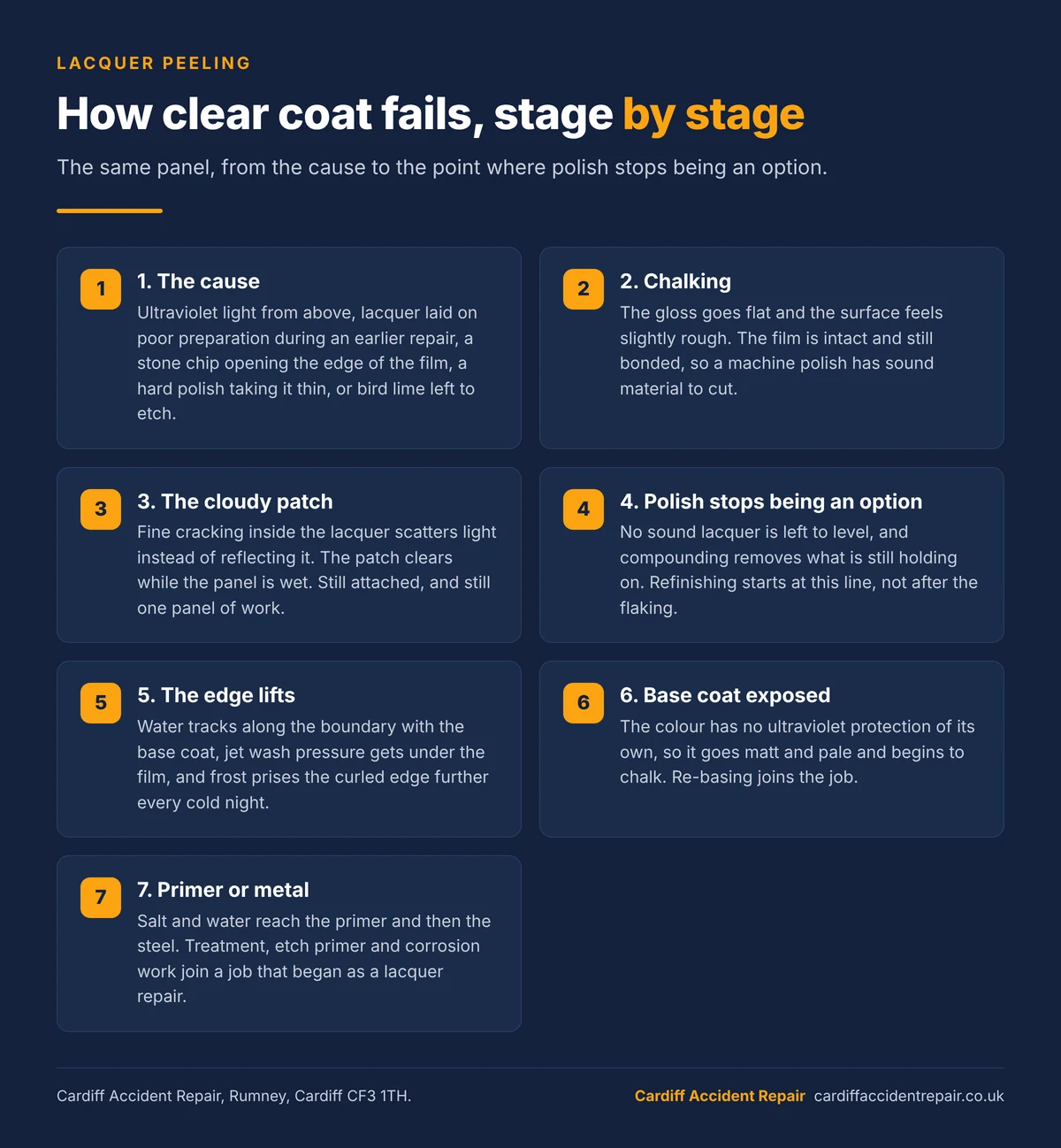
- The cause. Sunlight, poor preparation, a stone chip, a hard polish, or bird lime.
- Chalking. Gloss flat, surface rough, film intact. A polish still has material to cut.
- The cloudy patch. Cracking inside the lacquer scatters light. It clears when wet, and is still attached.
- Polish stops being an option. No sound lacquer is left to level. Refinishing starts here.
- The edge lifts. Water, jet wash pressure and frost prise the boundary with the base coat apart.
- Base coat exposed. The colour has no ultraviolet protection of its own. Re-basing joins the job.
- Primer or metal. Salt and water reach the steel, so corrosion work joins the repair.
How a failing lacquer is repaired
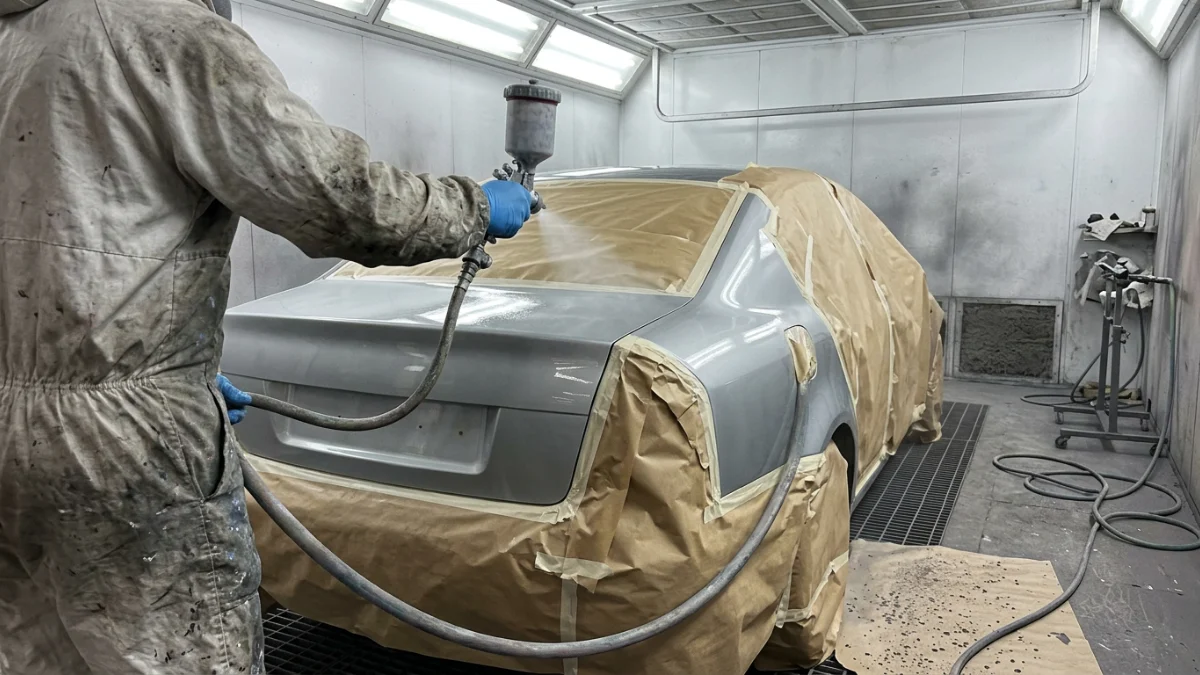
A failing lacquer is repaired by taking the panel back to sound material, rebuilding the colour where it has gone, and laying a full film of new lacquer across the whole panel.
Flatting back to sound base coat or primer
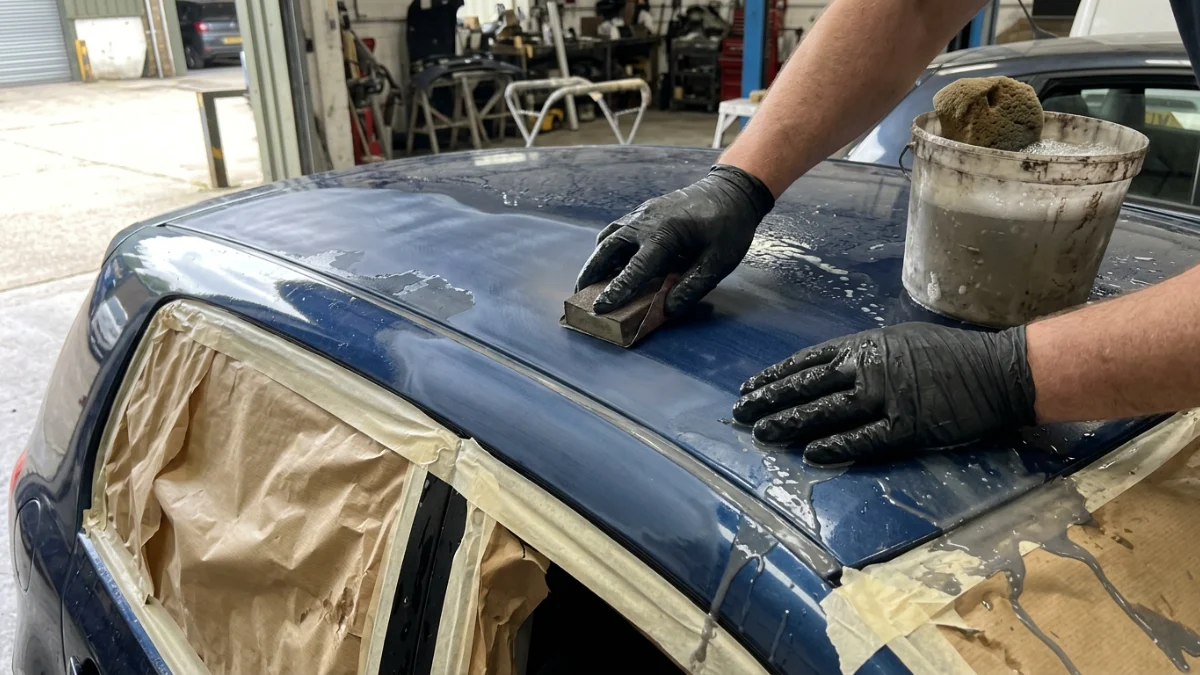
The panel is washed, degreased and masked, then flatted wet with progressively finer abrasive until every piece of failing lacquer is off. The edge of the repair area is feathered, so the transition is a taper rather than a step that telegraphs through new paint.
How deep it goes depends on what is found. Where the base coat is intact, flatting stops there. Where it has chalked or been sanded through, the area comes back to primer, and exposed metal takes etch primer. The assessment happens on the car at strip down, and the quote follows it.
Re-basing, re-lacquering and blending into the next panel
Colour comes from the paint code on the VIN plate or in a door shut, and it is never used straight from the tin. The code is mixed, sprayed on a card and held against the panel in daylight, because paint that has stood outside has shifted.
Base coat goes over the prepared area and is carried past it so the colour has somewhere to fade. Lacquer then goes over the whole panel, edge to edge, and is blended into the adjacent panel so the join between old film and new falls in open space. The same discipline governs bodywork repairs of every kind.
Why the repair is done panel by panel, not as a spot
A failing lacquer is refinished a whole panel at a time because the degradation is not confined to the patch that shows. The film has aged across the whole panel, so new lacquer over part of it leaves a boundary that catches light and a remainder that fails next.
Spot repairs have a place. A stone chip or a local scuff in a sound film can be repaired in a small area and blended. Depth decides the method on dent and scratch repair.
A peeling panel offers none of that. New lacquer cannot be stopped in mid air: the film has to reach a natural break, such as a swage line or a shut line, or be blended out into the panel next door. An edge left in open space shows as a hard line in daylight. How far the work travels is the judgement that also decides whether a panel is beaten or replaced, which panel beating against panel replacement sets out.
What each stage of clear coat failure needs
Every stage adds a step the one before it did not need.
| Stage on the panel | What you see | What the repair involves | What waiting costs |
|---|---|---|---|
| Chalked and dull | Gloss gone flat, surface feels rough | Machine polish, as a holding measure | The film keeps thinning |
| Cloudy or milky patch | Milky area that clears while wet | Flat back and re-lacquer the panel | Colour work joins the job |
| Edge lifting and flaking | A flake that catches a fingernail | Flat back, feather, re-base, re-lacquer | The peel travels across the panel |
| Base coat exposed | Matt, pale colour with no shine | Back to primer, re-base, re-lacquer, blend | The primer takes water |
| Primer or metal showing | Grey primer or bright metal | Treat, etch prime, rebuild the paint | Corrosion starts in the panel |
The last row is where a paint problem becomes a metal problem. Once primer is open to salt and water the panel itself is at risk, and what moves a quote between rows is on what moves the price of a bodywork repair.
What a Cardiff winter does to a lifting lacquer edge
A Cardiff winter attacks a lifting lacquer edge from three directions at once. Standing water never fully dries off a panel, road salt off the A48 and the M4 holds that water against the paint, and every frost expands whatever has worked its way underneath.
Salt is the part drivers underestimate. Cardiff Council grits the main routes across the city when temperatures fall, and the spray off Newport Road and the A48 coats everything driving through it. Salt keeps a surface damp long after the rain stops, so a lifted edge holds a wet pocket against the base coat and the primer.
Dark wet afternoons supply the rest. Cars are parked wet and stay wet, and a jet wash near a lifted edge finishes what the salt started. A peel that is small in November is a panel in March. Wheels carry a lacquer of their own and lose it the same way, so alloy wheel refurbishment starts by stripping the old film.
The honest advice is to get the edge sealed before the wet months rather than after them. Paint condition is not a testable item in the DVSA MOT inspection, although corrosion in a prescribed area is, so the warning has to come from looking at the car. The workshop is on Wentloog Road in Rumney, in the CF3 postcode on the east side of Cardiff, a short run from the A48 and the M4. The routes in are on the areas we cover, alongside the jobs booked as accident repair in Newport.
Get the edge sealed before the salt goes down
A lacquer repair booked now goes into winter with a full film on the panel. Send a dry daylight photograph with your registration and we will tell you which stage it has reached.
Questions about peeling lacquer
Does peeling lacquer fail an MOT
Paint condition is not an MOT item. The DVSA inspection covers corrosion in prescribed areas and sharp edges from damaged bodywork, so a panel can be peeling badly and still pass. The test gives no warning, so the timing of the repair is yours.
Is peeling lacquer covered under a paint warranty
Manufacturer paint warranties cover defects in the original finish and run for a period that varies by maker, so the first call is a franchised dealer with the service history. Present the car before anybody refinishes the panel, because a goodwill claim is rarely entertained later.
Can you lacquer over the bad patch to stop it spreading
New lacquer over a failing film fails with the film beneath it. The bond is to the old clear coat rather than to anything sound, so the patch lifts again and takes the new material with it. It leaves a hard edge as well.
Will the new lacquer match the rest of the car
Gloss and colour are both matched on the panel rather than from the code alone. Paint on a car that has stood outside has moved away from its code, so the mix is sprayed on a card and checked against the panel in daylight first.
Why has it only happened on the roof when the doors are fine
Horizontal panels take sunlight close to square for most of the day and hold water, dirt and bird lime where it lands. A door sheds all three and takes the same sun at a shallow angle. The roof is also the panel nobody looks at.
Can I leave it until the spring
A lifting edge gets worse every wet week, so leaving it until spring means a larger job than the one quoted in November. Water tracks along the boundary with the base coat, salt holds it there, and frost prises the film up each cold night.
Send a photograph of the patch and we will tell you whether it is still a lacquer job or a colour job. The workshop is in Rumney, Cardiff CF3 1TH, open Monday to Saturday, 9am to 6pm. Call 07400 454839 or use the contact form.
Two related guides sit alongside this one. Full respray against partial respray against a wrap covers what to do once the lacquer has gone, and how deep is my car scratch covers the damage that starts the failure in the first place.