
Filler is honest only where the metal behind it is sound, a let in repair panel is the answer once the steel has holes in it, and a full arch section or quarter panel is needed once the rot has reached the inner arch. You have seen a bubble on the rear arch and you want to know whether it is a morning of work or a week in the workshop. The three repairs last very different lengths of time, and the one you are offered often depends on who you ask. What settles it is the condition of the steel under the paint.
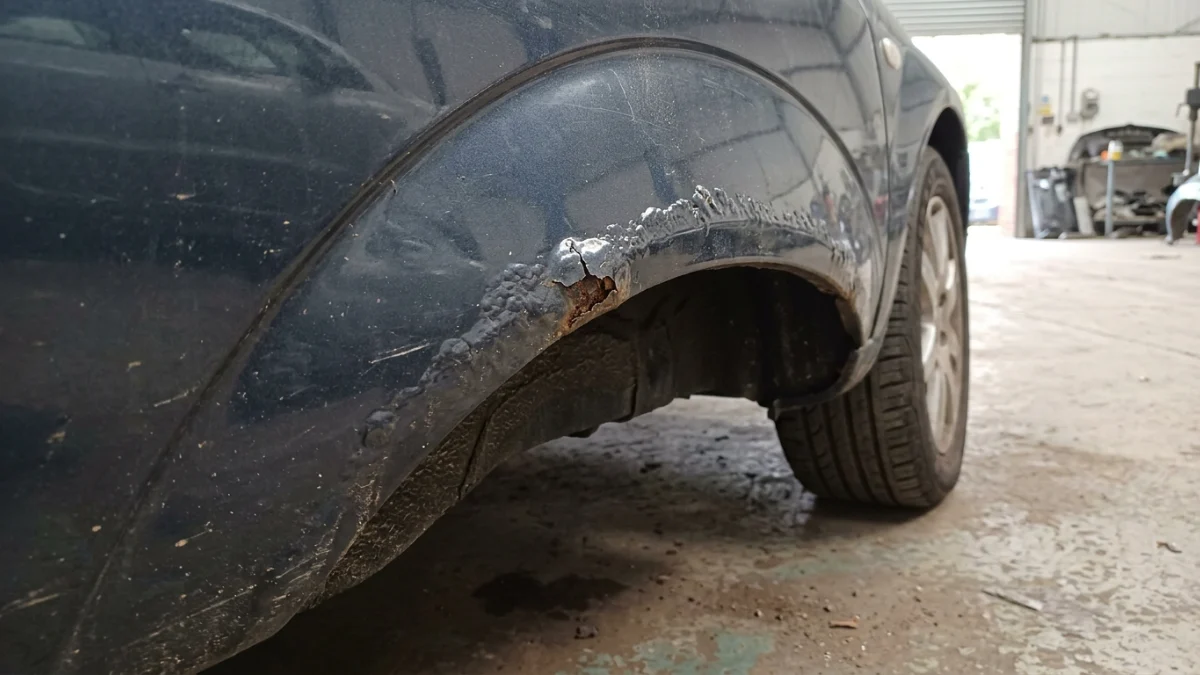
Why wheel arch rust starts at the lip
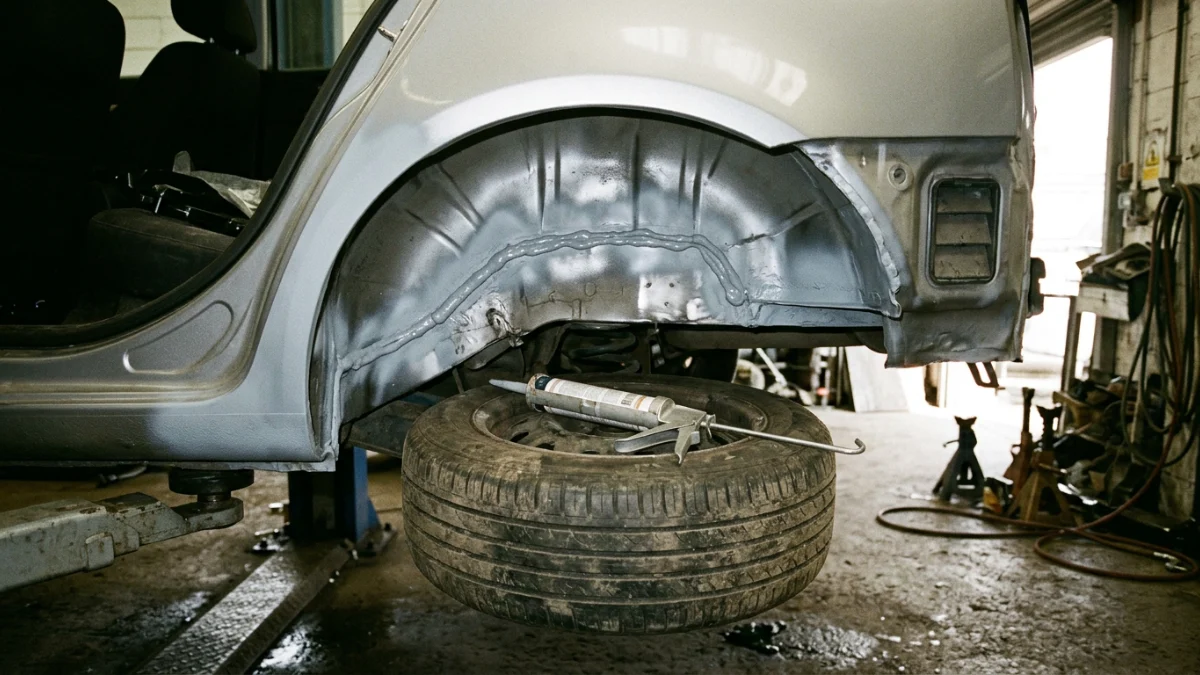
The rear arch lip is a folded seam. The outer quarter panel is turned under at the edge and joined to the inner arch, so two layers of steel sit face to face with a thin line of sealer between them. That fold is the dirtiest part of the panel and the slowest to dry.
Three things happen in there together. Wet mud packs into the fold and stays wet for days after the road has dried. Road salt dissolves in that water, so the steel corrodes from inside the seam outwards rather than from the paint inwards. The liner is clipped to the lip through punched holes, and every clip is a place where the paint was broken at the factory.
Rear arches go before front arches, because no engine bay heat sits behind them and the rear liner traps more. The repair that is honest for a bubble is not the one that is honest for a seam which has been corroding for years.
What each of the three repairs is honest for
Each method belongs to a condition of metal, not to a budget.
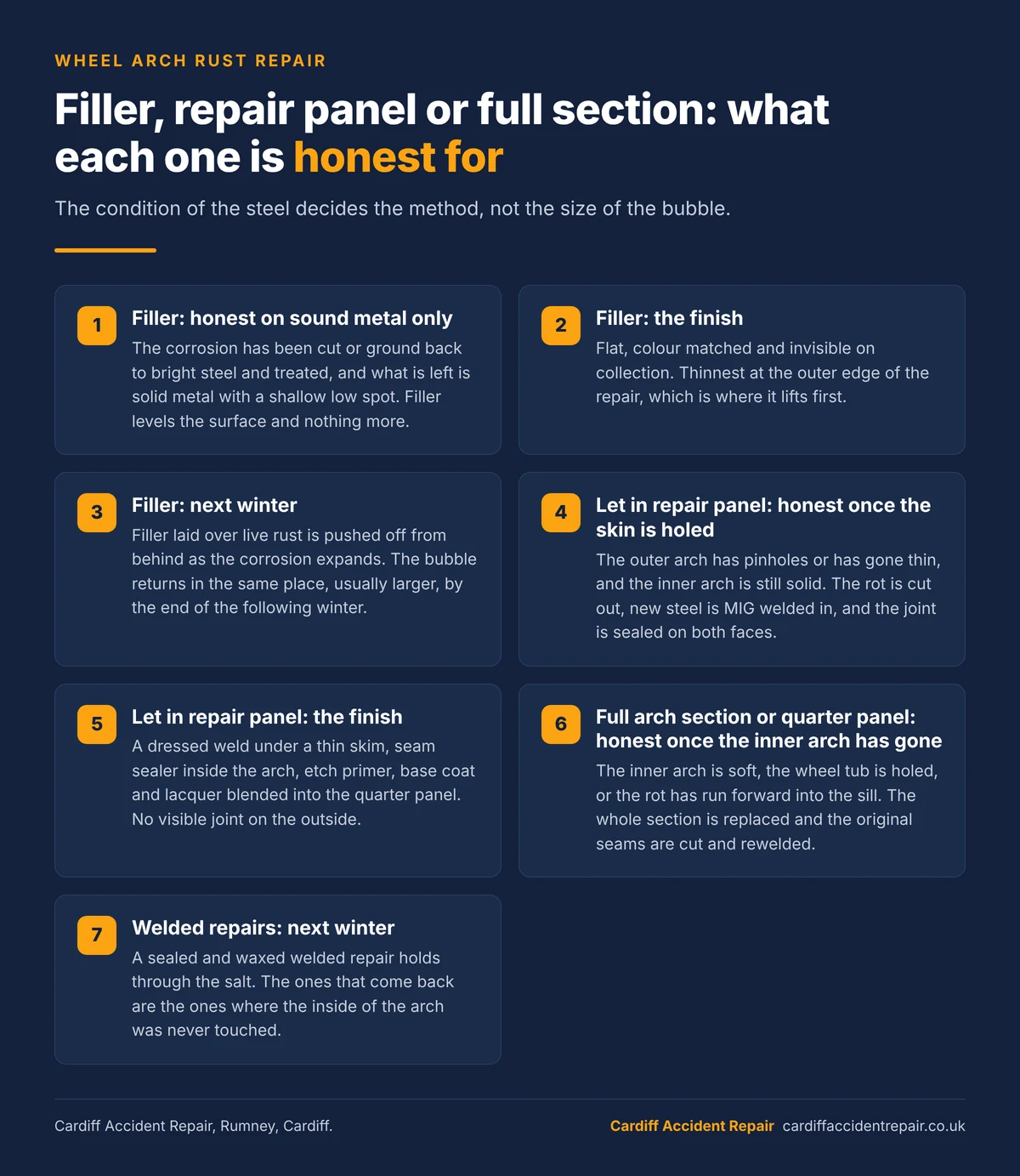
- Filler is honest on sound metal only. The corrosion has been ground or cut out and the bare steel treated, leaving solid metal with a shallow low spot. The finish is flat and colour matched, thinnest at the edge, and the bubble comes back next winter if any rust was left under it.
- A let in repair panel is honest once the skin is holed. The outer arch has pinholes or flexes under a thumb while the inner arch is still solid. New steel is welded in, the weld is dressed under a thin skim and blended out, and the repair holds where the inside was sealed.
- A full arch section is honest once the inner arch has gone. The inner arch is soft, the wheel tub is holed, or the rot has run into the sill. A new panel and new seams blend wider across the car, and the structure is sound again.
Only one of those three conditions can be judged from outside the car.
What filler over rust actually does
Filler over live rust hides the bubble and feeds it. Iron oxide occupies more room than the steel it was made from, so corrosion expands as it grows, and filler laid on top is pushed off from behind rather than worn off from the front.
Two mechanisms do the damage. The first is the water supply: rust in an arch seam is fed from inside the arch and through the clip holes, while filler is applied to the outside. The second is the filler itself. Polyester filler is porous and takes up moisture through its cut edges, so a skim over corrosion gives the rust room to grow.
What the owner sees is a flat, correctly coloured arch on collection, and the same bubble in the same place by the end of the following winter, usually larger than the one that was covered. The paint lifts at the outer edge first, because the filler is thinnest there. Photograph the bubble before anyone touches it, as our guide to photographing car damage for a quote sets out.
Filler has one job on an arch: the last fraction of a millimetre once the metal is true. Used anywhere else, it is a dated cheque.
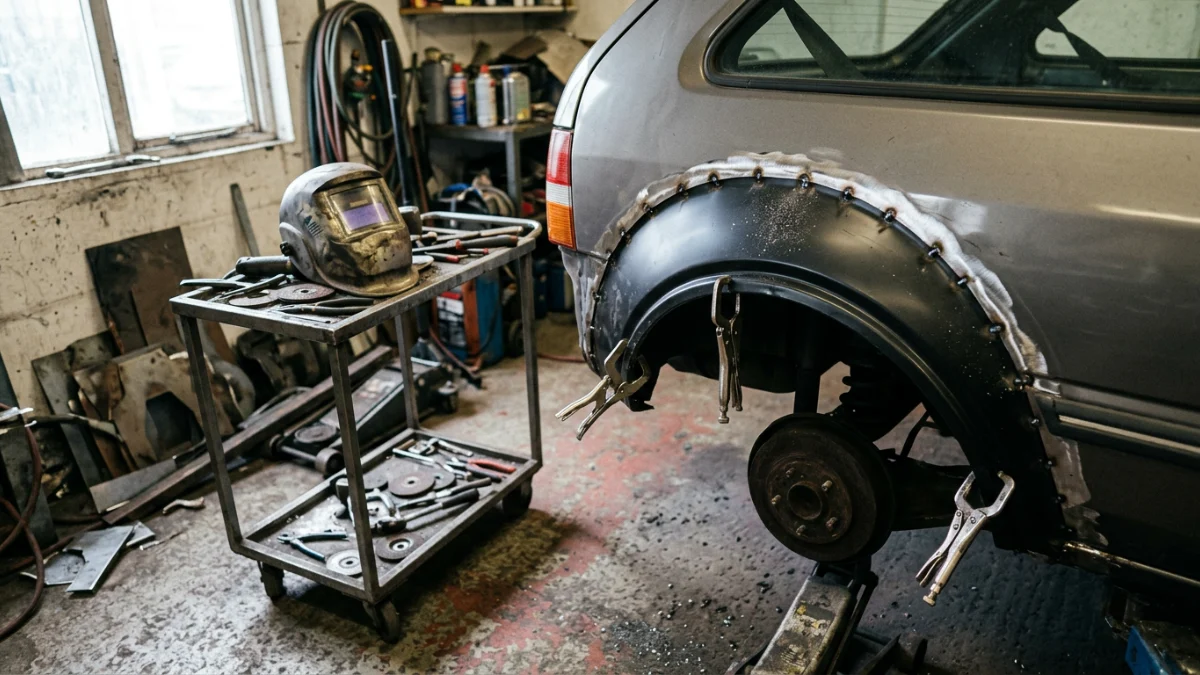
How a repair panel is let in
A let in repair panel is new steel welded into the hole left after the rotten metal has been cut away. The phrase describes the method, not the part.
- The rot is cut out back to clean steel. The cut runs past the last trace of corrosion rather than up to it. Thin metal is still rotten metal.
- The replacement steel is formed. Pressed arch panels exist for common models. Where none does, the piece is made in the workshop and worked to the arch profile, the metalwork described in panel beating against panel replacement.
- The panel is offered up and clamped. The gap is set so the edges meet rather than overlap. An overlapped joint is a new seam that traps water as the original did.
- It is MIG welded in short runs. Stitching the joint and letting it cool keeps heat out of the panel. Continuous welding pulls a thin outer skin and leaves a wave.
- The welds are dressed back. The joint is ground flush, checked with a flat hand, then skimmed thinly where it needs levelling.
- Both faces are protected. Seam sealer along the joint, etch primer and cavity wax inside the arch. This stage is invisible on handover and decides whether the repair is sound in five winters.
- Primer, base coat, lacquer, blend. The colour is mixed to the car’s paint code and blended into the quarter panel so there is no hard edge, as our paint and spray repairs page sets out.
Most of those stages leave nothing to see in the finished job, which is why a welded arch takes longer than the paintwork suggests, as how long accident repair takes explains.
Found a bubble on your arch this week?
Send a photograph and we will tell you which of the three repairs it is likely to need, then confirm it with the liner off. Rumney, Cardiff, Monday to Saturday, 9am to 6pm.
When a full arch section or a quarter panel is the honest answer
A full section is the honest answer once the rot has left the outer skin. Five findings put a car in that group, and one is enough.
- The inner arch is soft. A screwdriver pressed against it goes in. The inner arch carries the lip, so patching the outside welds new steel to rotten steel.
- The wheel tub is holed. Daylight through the tub, or water in the boot floor on that side, means the rot has reached a closed cavity.
- The rot has run into the sill. Arch and sill meet at a joint that collects everything the arch does, and rot crossing it changes the job, which is covered on our rust and sill repair page.
- The lip has gone along most of its length. A row of patches leaves a row of joints. One section replaced in one piece leaves one.
- The arch has been repaired before and come back. Corrosion was left in, or the inside was never sealed.
There is a regulatory line as well. The DVSA MOT inspection manual treats corrosion within 30cm of certain mountings and structural components as a prescribed area, and corrosion that has weakened metal inside it is a failure rather than an advisory. Arch rot that has reached the sill or a suspension mounting is on the wrong side of that line, which is why the inner arch is probed and not glanced at.
What each depth of rot needs
| Under the paint | What the metal is doing | The honest repair | What filler would hide |
|---|---|---|---|
| Bubbled paint, sound metal beneath | Surface corrosion in a stone chip | Ground back, treated, thin skim, refinished | Nothing, the one case where filler belongs |
| Pinholes, or the lip rotted through | The seam has rusted through from inside | Lip section cut out, repair panel let in | Live rust in the fold, and a hole bridged by a skim |
| Inner arch soft or holed | Corrosion has crossed into the structure | Full arch section or quarter panel | Rotten metal carrying the lip and clips |
| Rot continuing into the sill | The arch to sill joint has failed | Section repair to both, assessed together | An MOT failure point under fresh paint |
Those rows look the same from two metres away, which is why the row cannot be chosen from a photograph.
How the extent is found before any price exists
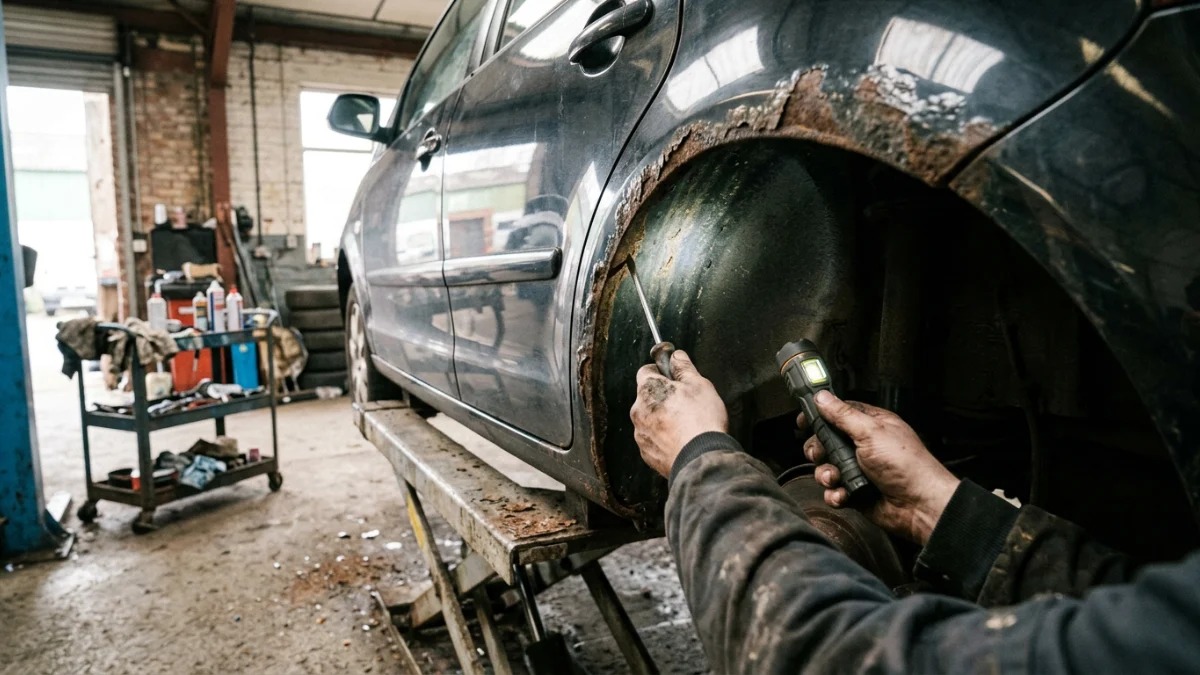
The extent is found with a scraper, a screwdriver and a torch, with the wheel off, the liner out and the car on the ramp. The outside of the panel shows where the rust has surfaced. It shows nothing about how far it has run inside the seam.
- Loose paint is scraped back. Paint that lifts under a scraper was never attached to sound metal, and the scraped area is always wider than the bubble.
- The steel is probed. A screwdriver pressed firmly against the lip and the inner arch finds the edge of the rot. Sound steel rings and resists. Rotten steel gives.
- A torch goes inside the arch. The wheel tub, the back of the lip and the arch to sill joint are visible from in there and nowhere else.
This is the position we will defend on any rust job. The damage is assessed on the car at strip down, and the quote follows the assessment rather than the other way round. A figure given over the phone is a guess about metal nobody has touched. What moves a figure is on our bodywork repair prices page, and the work it sits alongside is on bodywork repairs.
Why Cardiff winter puts the arches first
Gritted roads throw a salt slurry straight into the wheel arch, and the liner holds it against the lip for the rest of the winter. That is the mechanism behind almost every arch we cut out in Rumney. Rock salt lowers the freezing point of water, which is why Cardiff Council spreads it on priority routes, and dissolved salt keeps a film of water working on bare steel long after the road looks dry.
The daily route decides how fast it happens. A car on the A48 and the M4 collects spray from every vehicle in front of it, and that spray is salt water with grit in it. Newport Road gets the same from the gritters. A car left outside overnight in CF3 holds the slurry in the arch until the next drive, because nothing inside a liner dries at a standstill.
Two things make it worse. Stone chips off a gritted road break the paint on the arch edge and the sill, which gives the salt its starting point, as our dent and scratch repair page explains. The same salt lifts the lacquer on alloy wheels from a kerb scrape, which is why alloy wheel refurbishment fills the same months. Cars reach us from across east Cardiff and from Newport, Caerphilly and Penarth, and the full list is on areas we cover.
What a good arch repair looks like six months later
Both repairs look identical on the day the car is collected. The difference shows after a winter, in the same few places every time.
A repair that is holding
The paint is still tight at the outer edge, with no hairline following the shape of the work. A torch inside the arch finds a continuous bead of seam sealer and primer or wax over the bare metal.
A repair that is coming back
A hairline crack traces the outline of the old repair, which is filler shrinking while the metal behind it moves. Small blisters appear at the clip holes first, because water reaches the bare edge there. The lip gives under thumb pressure, or sounds dead when tapped. Inside the arch there is bare filler and no sealer on the joint. A repair done only from the outside was never a repair of the rust.
Getting an arch looked at in Rumney
Bring the car in and the answer takes minutes, because the liner comes off and the metal gets probed while you wait. Ali Hindal assesses this work himself at the Rumney workshop, so the person telling you which repair your arch needs is the person who will carry it out. One winter can move a car from a let in panel to a quarter panel.
Have the arch probed before the salt season does it for you
We will take the liner out, find the edge of the rot and tell you whether it is filler, a repair panel or a section.
Questions about wheel arch rust repair
Can wheel arch rust be repaired without welding?
Yes, where the metal is still sound once the corrosion has been removed. Surface rust in a stone chip is ground back to bright steel, treated, skimmed thinly and refinished. Once the steel is holed or thin there is nothing solid for a skim to sit on.
Is it worth repairing a rusty wheel arch?
Repairing it is worth doing while the inner arch is still solid, because the job then stays in the outer skin. Rust travels along the seam towards the sill and does not stop on its own, so the same arch left another winter becomes a structural job.
Will a rusty wheel arch fail an MOT?
A rusty arch fails when corrosion has weakened metal in a prescribed area. The DVSA MOT inspection manual defines that as the area within 30cm of certain mountings and structural components, which on a rear arch brings in the sill and the seat belt anchorages. Outer skin corrosion away from those points is usually an advisory.
How long does a welded arch repair last?
A welded repair lasts as long as its sealing does. New steel butt welded into clean metal, seam sealed along the joint and waxed inside the arch, is as sound as the panel around it. The ones that come back early were never treated inside.
Can you repair one arch and match the paint?
Paint is mixed to the car’s colour code and blended out into the quarter panel, so the join is not where the eye looks for it. Matching one arch on a metallic or faded car means spraying into the adjacent panel rather than stopping at a body line.
Why is the rust worse than it looked?
Arch rust grows inside a folded seam and reaches the paint last, so the bubble is the end of the process rather than the start. The corroded area under the paint is wider than the blister on top almost every time.
Send a photograph, or bring the car to Rumney and we will take the liner off and tell you which repair it needs. Cardiff Accident Repair, Unit 4, Wentloog Buildings, Wentloog Road, Rumney, Cardiff CF3 1TH, Monday to Saturday, 9am to 6pm. Call 07400 454839 or use the contact form.