
Car Body Repair for Barry Drivers
Cars kept in Barry corrode faster than cars kept five miles inland. Salt in the air sits on paint and bare alloy all year rather than only after a gritting run, so a kerbed wheel or a stone chip that an inland car carries for years will lift and spread here in a single winter. That changes the repair decision more than most people expect, and it is the reason a cheap touch in on a coastal car is usually money wasted. Most people ask the same thing first: will the repair show? On a faded coastal car that depends on your colour being read off the car rather than off a plate. The drive to our Rumney workshop, with its on-site spray booth, is thirty to thirty five minutes off peak, and Ali Hindal will give you a written quote after the strip down rather than a guess from the pavement.

How long is the drive from Barry to Rumney
Thirty to thirty five minutes off peak, on the A4050 to the A4232 and then the A48 east. Add fifteen to twenty minutes at school run and rush hour, most of it on your approach to Culverhouse Cross rather than at our end.
The A4055 through Dinas Powys and Penarth is the alternative from the Waterfront or the Docks end of Barry, trading a faster road for a shorter one. On a Saturday it is usually the better choice. On a weekday morning it is not.
Rumney sits on the eastern edge of Cardiff, so you will cross the city to reach us. That is worth knowing before you set off with a car you are not sure about. Routes from every direction, and what to do if the car will not make it, are on the areas we cover.
What salt air does to paint and wheels
It turns small damage into spreading damage, by giving corrosion a permanent supply of the one thing it needs. Inland, a chip in the paint sits dormant through dry weeks. On the coast it does not get dry weeks.
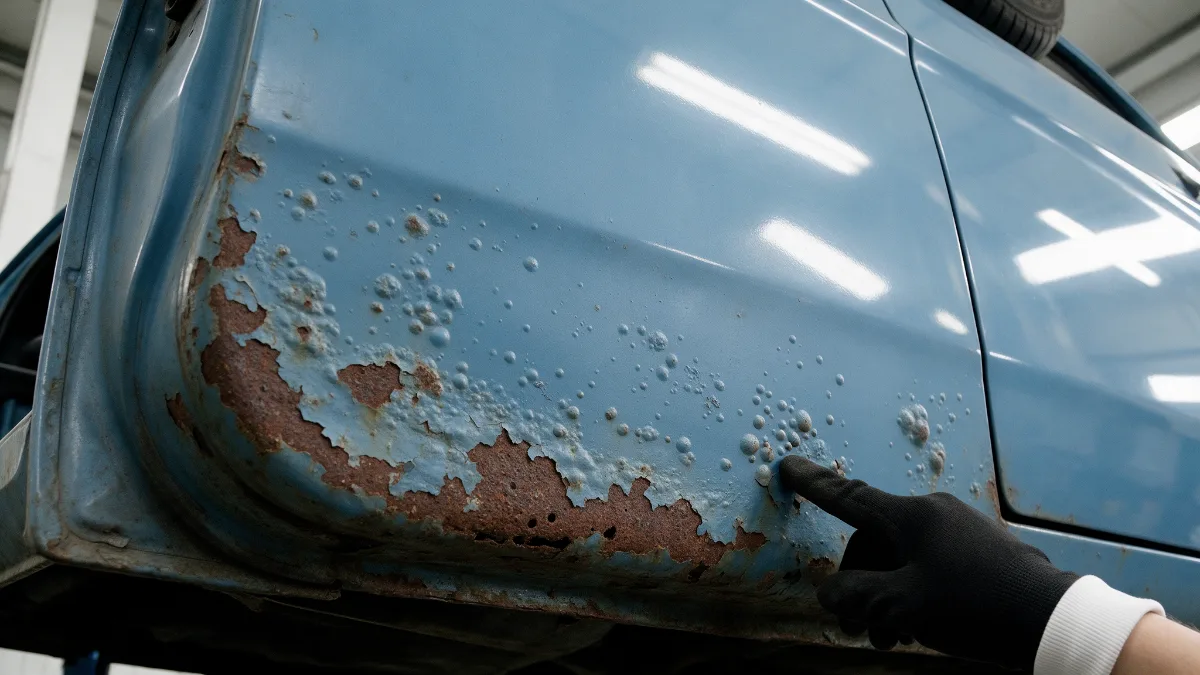
Paint fails at edges and breaks, not in the middle of a flat panel. On your car the places to look are the arch lips, the door bottoms, the boot shut, the leading edge of the bonnet and anywhere a previous repair was feathered out. Once moisture gets under the film it lifts the paint from behind, which is why coastal corrosion often shows as a blister or a lifted edge before it ever shows as rust you can see.
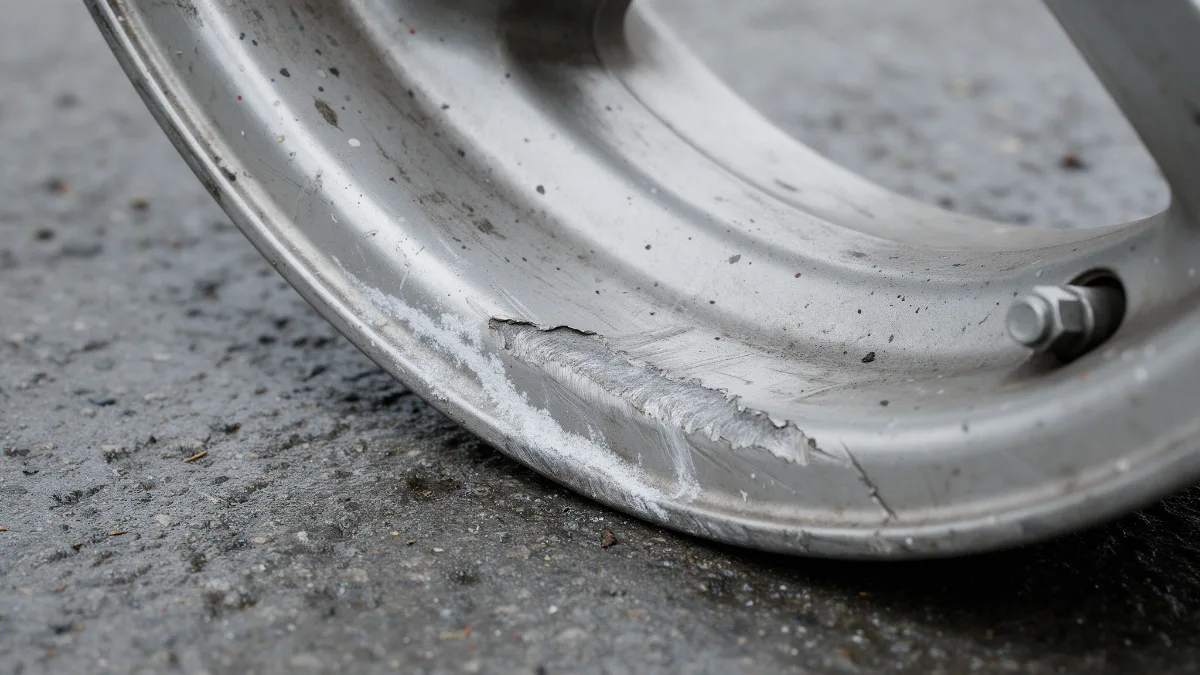
Bare alloy behaves the same way. A kerb scrape through the lacquer on your wheel exposes metal that then oxidises under the remaining finish, spreading a white powdery line out from the damage. That is the mechanism behind most of the wheels that come in from the coast, and it is covered on alloy wheel refurbishment.
Why a cheap touch in costs more on a coastal car
Because painting over corrosion seals it in rather than stopping it, and on a car that lives in salt air there is almost always something already under the edge of the damage.
A proper repair removes the affected metal or takes the surface back to sound material, treats what is left, then primes, colours and lacquers. A touch in pen does the last step and skips the first three. On a dry inland car that can hold for a couple of years, because there is not much moisture to feed. On your car, parked within sight of the water, it buys you a winter.
The same logic decides repair against replacement on a panel. If your door has a dent and a sound edge, that is a repair. If it has a dent and a bubbled bottom edge, that is a conversation, because the dent is the cheap part. How that call gets made is on panel beating against panel replacement.
Seafront and car park damage
Bumper corners, door edges and wheels account for nearly all of it, which is the cheapest category of bodywork to put right and the easiest to leave sitting on your drive too long. Your scuffed bumper corner is a cosmetic job until the paint breaks and the plastic behind it starts taking water.
Barry Island and the Waterfront car parks in summer produce the familiar pattern of tight bays, open doors and reversing drivers, none of whom were looking at your car. Nobody leaves a note on your windscreen. If you come back to damage and no driver, photograph it where it sits before you move the car, note the time and look for a camera. Whether the car park operator carries any liability, and how to ask for footage before it is overwritten, is set out in who pays for car park damage.
A scuff rather than a split is usually one panel of paint and a day. Worth doing before the winter rather than after it.
Road damage claims in the Vale of Glamorgan
Vale of Glamorgan Council is the highway authority for roads in and around Barry, so a claim for a wheel or a tyre destroyed by a pothole goes to the council rather than anywhere else. The exception is the trunk road network, which belongs to the Welsh Government.
That matters on the A4232, which is a trunk road managed by the South Wales Trunk Road Agent rather than by the council. Send a trunk road claim to the Vale and it will be returned to you weeks later, by which time the defect has been filled and your evidence has aged.
Whichever authority it is, the claim is decided on records. Photograph the defect with something in shot for scale, note the date, time and direction, and keep the invoice for the repair. Expect to be told that the road was inspected to a reasonable standard, because that is the standard defence.
What Barry customers bring in most
Wheels, paint repairs on edges and corners, and bumper work, in roughly that order, and your car will usually need more than one of them. It is a visibly different mix from the structural work that comes in from the motorway towns.
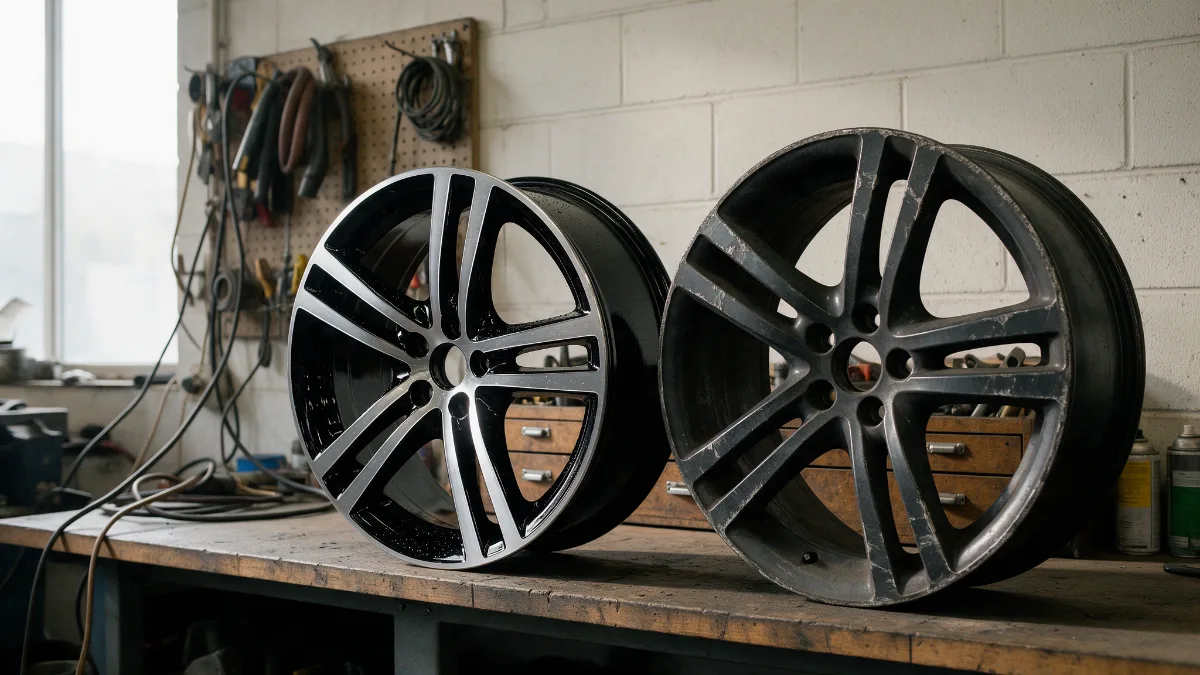
Wheels come in as a set more often than as a single, because once one of your wheels is refurbished the other three look worse. The finish on your wheel decides the method: a painted or powder coated wheel is stripped, filled and refinished, while a diamond cut wheel has to go on a lathe and can only take that treatment a limited number of times.
Paint work on a coastal car is usually a blend rather than a single panel, because matching the faded finish on your car, after years of sun and salt, is not a case of reading the code off the plate and spraying. How colour is matched, and why blending into the next panel is part of a proper job rather than an upsell, is on paint and spray repairs.
Should you claim or pay for corrosion related damage
Corrosion itself is not an insurance matter, because your policy covers sudden damage rather than wear. What insurers do cover is the accident damage, and that is where the line gets argued.
A wheel you kerbed last month that has since corroded is claimable, because the corrosion is the consequence of the strike. A wheel that has been quietly rotting for three years is not. The test an engineer applies to your claim is whether the condition is consistent with a single event.
On smaller jobs the arithmetic usually points away from claiming at all, once your excess and the effect on your no claims discount are counted. That comparison, with the numbers set out properly, is on claiming against paying for car damage.
Quotes by photograph before you drive over
Send photographs and we will tell you what we are looking at before you commit to the round trip across the city. What we will not do is give you a final figure from a picture, because on your car the question is always what is under the edge.
Take them in daylight, straight on and at an angle, with a wide shot that shows where the damage sits on your car. For your wheels, one photograph each, face on. For a lifted paint edge, get close enough that the lift is visible against the sound paint beside it, because that contrast tells us how far your repair has to go. What makes a photograph useful is on how to photograph car damage for a quote.
What a proper coastal repair involves
A proper coastal repair takes the damage back to sound material before any paint goes near it, and that is the step that decides whether the repair lasts a decade or a winter. Everything after that is ordinary paint work.
On a lifted edge the paint is cut back until it stops lifting, which is usually further than your damage looks. Affected metal is removed or treated, the surface is primed, and the colour is laid in and blended into the neighbouring panel so the repair does not sit as a patch. Lacquer goes on last and is what actually keeps the weather out, which is why a repair that skips a proper lacquer stage fails at the edges first.
On a wheel the sequence is the same idea in a different material. The finish comes off, the kerb damage is filled and shaped, and the wheel is refinished and lacquered as a whole rather than spot repaired, because a spot repair on a wheel leaves a join for salt to work at.
Dents and scratches on a car that lives outside
Whether the paint is broken decides everything here, because that is what separates a cosmetic job from a corrosion problem waiting to start. A dent with the paint intact can often be worked out without refinishing at all.
Run your fingernail across the mark. If it does not catch, the damage is in the lacquer and polishing may be the whole answer. If it catches, the scratch has gone through to the colour or the primer and the panel needs paint, and on a coastal car that should happen sooner rather than at a convenient moment.
Shallow dents with sound paint are the cheapest repair in the trade and the one most often left too long on cars like yours parked near the water. Where the line falls between pushing a dent out and refinishing the panel is on dent and scratch repair.
Book a body repair from Barry
We are at Unit 4 Wentloog Buildings, Wentloog Road, Rumney, Cardiff CF3 1TH, Monday to Saturday, 9am to 6pm, with six work bays and the spray booth on site. Come in on the A4050 and the A4232, then the A48 east to the Rumney turn. Send photographs of the wheels or the panel first and we will tell you whether it is one job or four. The wider capability is on bodywork repairs.
Questions from Barry drivers
Is coastal corrosion really faster than inland?
Yes, because salt in the air keeps damaged paint and bare alloy permanently supplied with the moisture and chloride that corrosion needs. The difference shows most at edges and on wheels.
Can you refurbish one wheel or do I need all four?
One is fine technically. In practice a freshly finished wheel next to three faded ones is obvious, so most people do them as a set once they see the first one back.
Who do I claim from for a pothole in Barry?
Vale of Glamorgan Council for ordinary roads. The A4232 and other trunk roads belong to the Welsh Government through the South Wales Trunk Road Agent, so that claim goes elsewhere.
Will my insurer pay for rust?
No. Policies cover sudden damage rather than deterioration. They will cover accident damage, and an argument can follow about how much of the corrosion flowed from the accident.
Is it worth repairing a bumper scuff before winter?
On a coastal car, yes, because a broken paint film is an open door. The same scuff left until spring is often a bigger job by then.
Can you match paint on a car that has faded in the sun?
Yes, by reading the existing paint rather than the code and blending into the adjacent panels. Spraying to the original code on a faded car is what produces a repair you can see from across the road.
Photograph each wheel face on, get close on any lifted paint edge, and deal with coastal damage before the winter rather than after it. Call 07400 454839 or use the contact form.