
Hit an Animal on the Road: Damage, Reporting and Repair
An animal strike carries a legal duty to stop and report for eight named kinds of animal, and no such duty for anything else, which surprises most drivers the first time they look it up. The damage usually looks smaller than it is, because a body strike at speed loads the front structure behind the bumper. Your car is at the side of the road, you are shaken, and there is an animal involved as well as a car. Stop, follow the order below, then bring the car to the Rumney workshop, where Ali Hindal will give you a written quote after the strip down rather than from the outside.

Which animals must you legally report
The Road Traffic Act 1988 requires you to stop and report if you injure a horse, cattle, ass, mule, sheep, pig, goat or dog. That list is exact, and it does not include cats, deer, foxes, badgers or birds, which is why the advice you get from other drivers is so often wrong.
A collision with one of the eight must be reported to the police as soon as reasonably practicable, and in any case within twenty four hours, whenever details are not exchanged at the scene. Not knowing who the owner is does not remove the duty. Reporting it does.
For anything off the list, including a deer, you have no reporting duty, and there are still two good reasons to call anyway. An injured large animal on a carriageway is a danger to the next driver, and a police log of the time and place is useful evidence if you later claim on your own policy.
What should you do at the scene
Make the scene safe, keep away from the animal, then report and photograph, in that order. A frightened large animal is more dangerous than the collision was, and a horse or a bullock in pain will move unpredictably.
- Pull in and put your hazards on. On a rural road at dusk, the next car has the same sight lines you had. Light yourself up before you do anything else.
- Do not approach a large injured animal. Call it in and let people with the right equipment handle it. Approaching a panicking horse is how a damaged car becomes an injured driver.
- Call the police on 101, or 999 if the road is blocked or anyone is hurt. Give the exact location, the animal and whether it is still on the carriageway.
- Photograph the car, the road and the position. The same evidence set as any other accident, and it is what supports a claim on your own policy later.
- Look underneath before you drive off. Fluid on the road, a hanging undertray or a dropped lamp means it is a recovery rather than a drive home.
- Note anything about where the animal came from. A gate off its latch or a broken fence line matters, because livestock that escaped through somebody’s negligence changes who pays.
The damage question starts once your car is safe. The way to photograph it so a workshop can quote properly is in photographing car damage for a quote.
Why is the damage worse than it looks
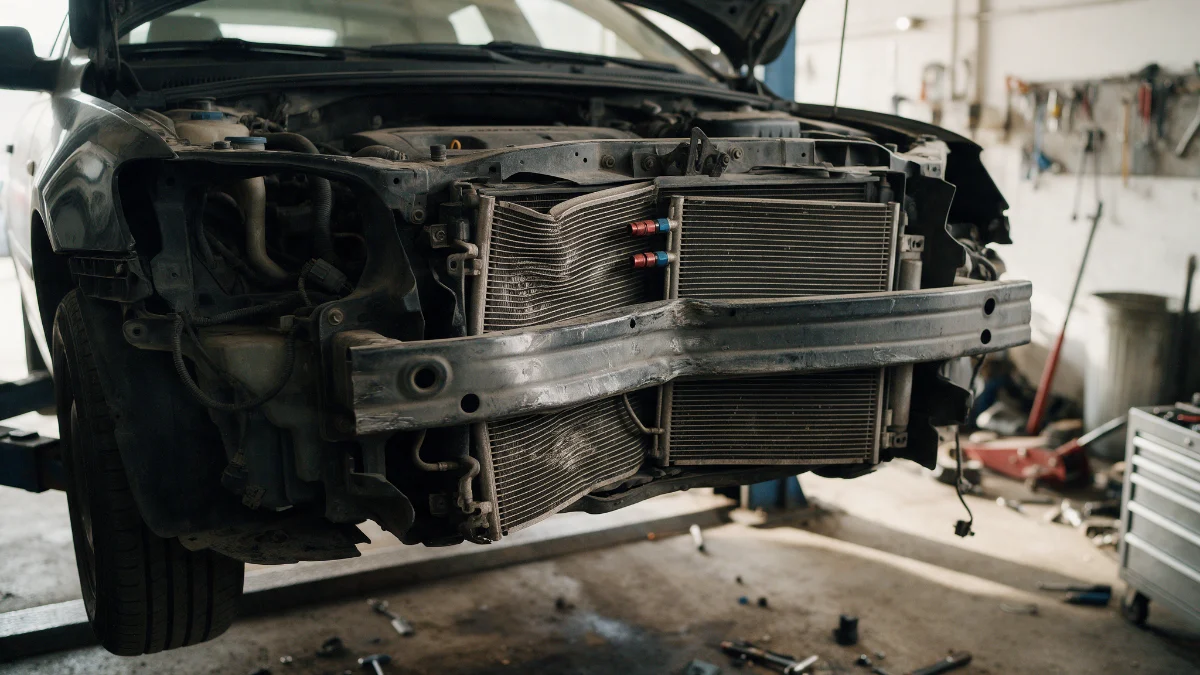
An animal strike loads the front structure rather than scuffing it, so the visible damage sits on the bumper cover while the cost sits behind it. A deer or a sheep at speed is a mass arriving at bonnet height, and the energy goes somewhere.
What gets hit behind the cover is predictable. The absorber and crash bar first, then the radiator and condenser, then the cooling fan, the intercooler pipework and the lower slam panel. Lamps crack at their mounting lugs rather than the lens, so a lamp that looks fine can be loose. Bonnet catches and hinges move. On a higher impact the crash cans deform, which is what they exist for, and they do not reset.
Then the electronics. Front radar and camera systems sit behind the grille or in the screen, washer jets and wiring run across the slam panel, and parking sensors live in the cover you are about to replace. Any of that being disturbed is a reason to check the aim afterwards rather than assume it. What sits behind a bumper is set out on bumper repair.
Will my insurance cover hitting an animal
Comprehensive cover pays for animal strike damage, third party only does not, and on most policies the claim is recorded as a fault claim because there is nobody to recover the money from. That last part is the one that costs you, not the repair.
A fault claim here does not mean anyone thinks you drove badly. It means your insurer paid and recovered nothing, which is the same accounting word that trips drivers up after a non-fault collision. That mechanism is explained on non-fault accident repairs.
One route exists where somebody else pays. Livestock that got onto the road because a gate was left open or a fence was not maintained may make the keeper liable, and that is why the photograph of the broken fence line matters. It is rarely simple and it is occasionally worth pursuing, particularly where the damage is heavy.
Should you claim or pay for it yourself
Work out your excess first, then get a written quote, then decide, because an animal strike often lands in the awkward band just above a typical excess. Below it, claiming gains you nothing and still marks your record.
The complication is that animal damage is easy to underestimate. A cracked grille and a scuffed bumper can turn into a radiator, a condenser and a crash bar once the car is open, and a repair you were happy to fund privately becomes one you would rather have claimed for. That is a good reason to get the strip down done before you commit either way.
We give the written quote after the car has been opened up, so the number you are deciding on is the real one rather than an outside guess. The wider decision is worked through in claim on insurance or pay for the damage yourself.
Is the car safe to drive afterwards
Stop driving if you see fluid on the road, a temperature warning, a bonnet that will not latch properly, or any airbag or brake warning light, because each of those points at something that gets worse with every mile. A car that looks driveable after an animal strike often is not.
Coolant loss is the common one. A holed radiator or a split hose empties quietly, and the first sign is a temperature gauge climbing ten minutes into a journey. Driving on from there turns a cooling repair into an engine repair.
Check the lamps work and the bonnet latches on both catches before you move. Listen for anything rubbing on a wheel. If the steering pulls or the wheel sits off centre, something in the suspension has moved and the car needs to go on a lift rather than a motorway. Structural checks are covered on accident and crash repair in Cardiff.
What the repair involves and how long it takes
A front end animal strike takes two to five days for a cover, lamp and grille job, and longer when cooling, structure or sensors are involved. The strip down comes first in every case, because nothing honest can be said about the timeline until the cover is off.
The order is strip, assess, order parts, repair or replace the structure, refit, then paint and blend. Parts availability is the usual variable, especially on a less common model, and that is outside anybody’s control. Paint curing is the other, and it cannot be hurried without the finish failing later.
A bumper cover that has split rather than shattered is welded and refinished rather than replaced, which is both quicker and cheaper. Where the crash bar has deformed, it is replaced, because it is a safety part and it has already done its job once. Full timelines across the workshop are in how long an accident repair takes.

What if you swerved and hit something else
A swerve that puts your car into a wall, a hedge or another vehicle is treated as an ordinary accident, and the animal does not change the liability position at all. That is the part drivers find hardest to accept, because the swerve felt like the only option at the time.
Your insurer will look at what you hit, not at what you avoided. Hitting an oncoming car makes it a third party claim against you. Hitting a wall or a verge makes it a single vehicle claim on your own policy, and your excess applies as usual. There is no deduction for good intentions.
It also tends to cost more. A braked impact with an animal loads the front structure in a straight line, which is what the car is designed for. A swerve loads a corner, and corner impacts reach the suspension, the steering geometry and sometimes the chassis leg, which is a different class of repair. Tell us it was a swerve rather than a straight strike when you book the car in, because it changes what we check first.
How do you avoid the next one
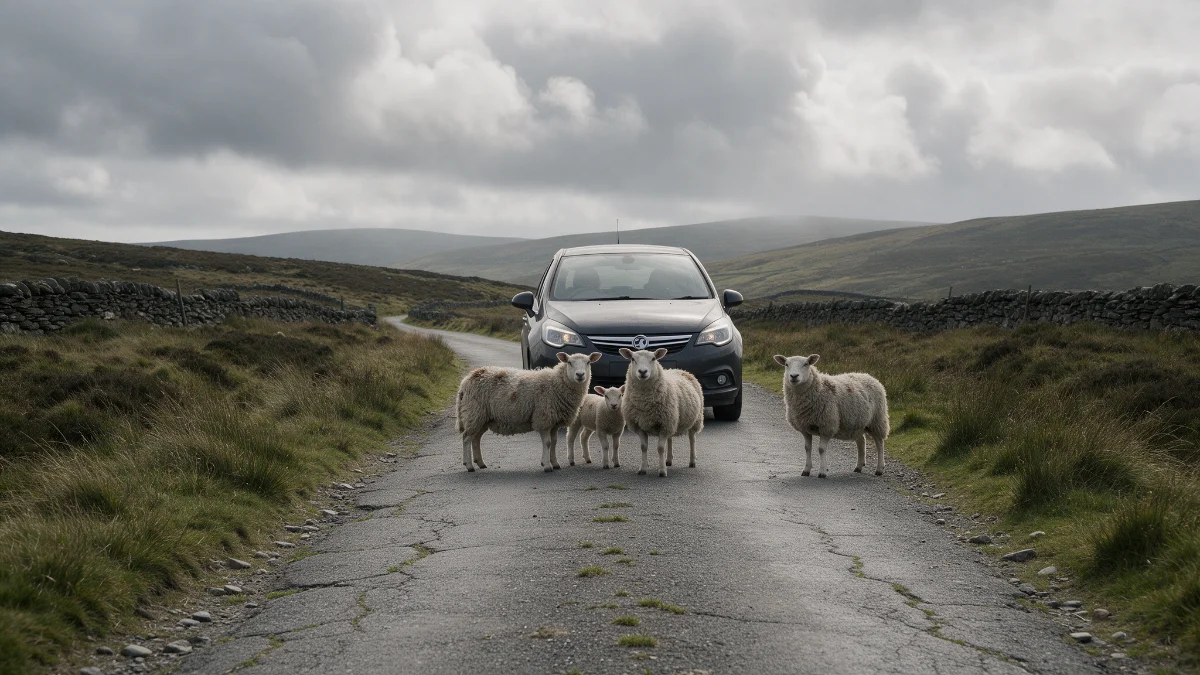
Animal strikes cluster at dawn and dusk between October and December on unlit rural roads, so the single most useful habit is slowing where hedgerow or woodland runs right up to the verge. You cannot steer around what you cannot see.
Deer travel in groups, so one crossing in front of you means more are coming. Brake, do not swerve. The animal is survivable and the oncoming car or the tree is not, which is the advice every police force gives and the one drivers instinctively ignore.
On the lanes around Cardiff, the specific risks are sheep on unfenced upland roads and dogs off the lead near parks and commons. Full beam where there is nobody to dazzle, dipped as soon as there is, and an eye on the verge rather than the centre line.
Get animal strike damage assessed in Cardiff
We are at Unit 4 Wentloog Buildings, Wentloog Road, Rumney, Cardiff CF3 1TH, Monday to Saturday, 9am to 6pm, with six work bays and an on-site spray booth. Send photographs of the front of the car and tell us whether you have seen any fluid underneath, because that changes whether you drive it here or we arrange recovery. Cars come to us from across Cardiff and the surrounding area.
Animal strike questions we get asked
Do I have to report hitting a deer?
No legal duty applies, because deer are not on the Road Traffic Act list. Call 101 anyway if the animal is injured or still on the road, both for the next driver and so there is a log supporting any claim.
Do I have to report hitting a cat?
Not legally, since cats are also off the list. Most people still try to find the owner or report it to a local vet, and there is nothing stopping you logging it with the police.
Will claiming for an animal strike cost me my no claims discount?
Usually yes, unless your discount is protected, because there is nobody for your insurer to recover from so it is recorded as a fault claim. Weigh the quote against your excess before you decide.
Can I claim against the owner of livestock on the road?
Sometimes, where the animal got out through poor fencing or a gate left open. Photograph the fence line and the gate at the time, because that evidence disappears within a day.
The car looks fine. Should I still have it checked?
Yes, if the impact was at any speed. The bumper cover is designed to spring back, and the parts behind it are not. A quick look on a lift costs you an hour and can save a cooling system.
My airbags did not go off. Does that mean it was minor?
No. Airbags fire on deceleration above a threshold, and an animal strike often sits below it while still damaging the structure and the cooling pack. Judge it on what the strip down finds, not on the airbags.
Check underneath before you drive off, report it if the animal is on the list, and send us photographs of the front of the car. Call 07400 454839 or use the contact form.