Rust repair and sill welding means cutting the corroded metal out, letting in a fabricated or pressed repair panel, MIG welding it to sound steel, then sealing, priming, painting and cavity waxing the repair so it does not come back. Most drivers arrive with an MOT advisory that says corrosion, or a finger that has gone through a sill they were wiping down. Neither tells you how far it has spread, because rust works outwards from inside a closed section and the paint gives way last. This page sets out the work, where rust starts in east Cardiff, how the extent is established, and when welding stops being the right answer.
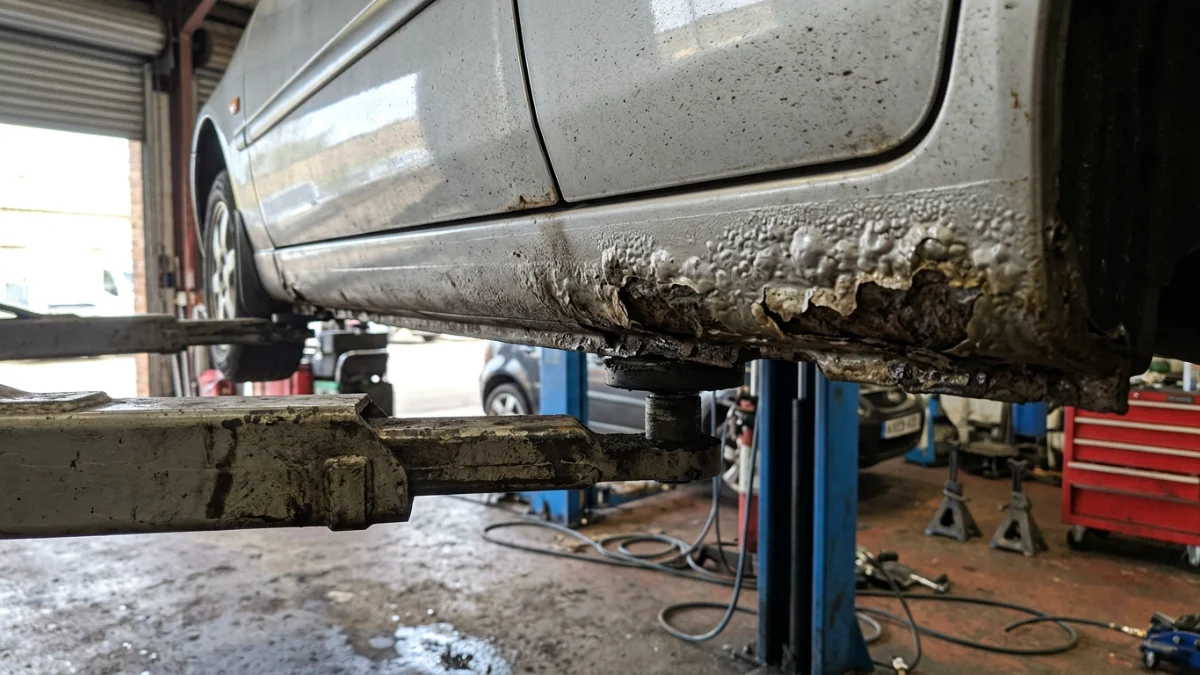
What rust repair and sill welding involves
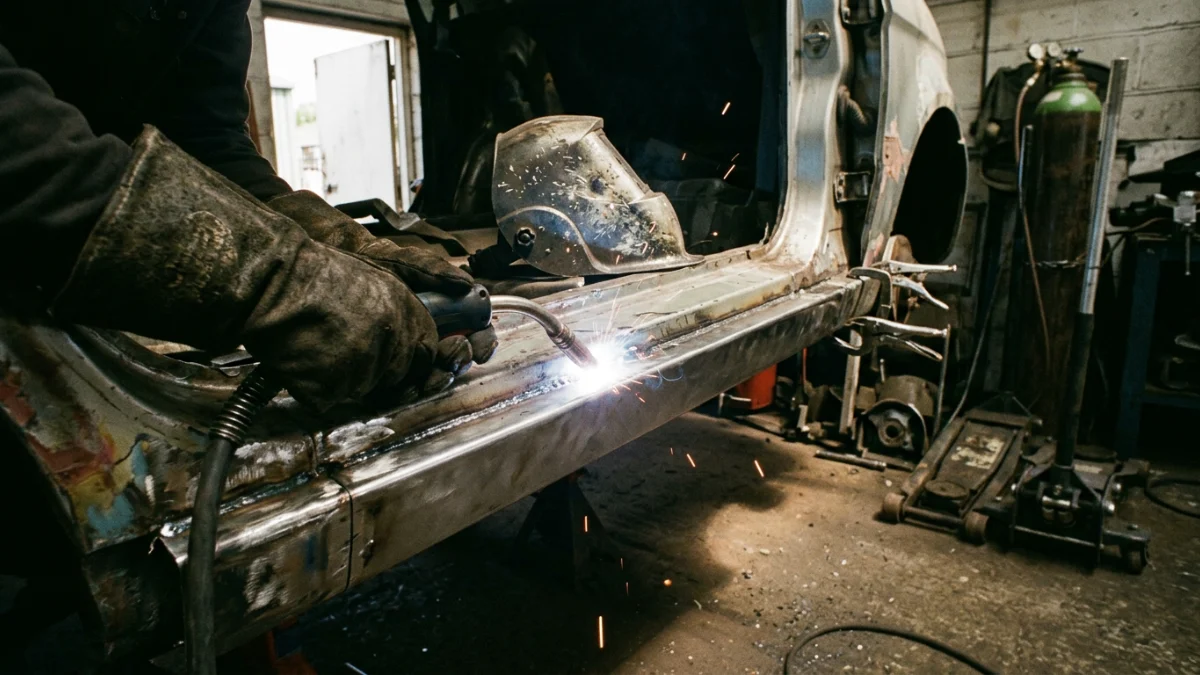
Rust repair is the removal of corroded steel and the welding in of new steel in its place. Nothing is filled or painted until the metal underneath is sound, because filler over rust lifts within a winter. Ali Hindal does the welding himself at the Rumney workshop.
- Strip and expose. Arch liners, sill trims and sound deadening come off so both sides are visible.
- Cut out. Rotten steel comes back to bright metal, cut where the steel still rings solid.
- Fabricate or fit. A pressed repair panel goes in where one exists, or a section is made on the bench in the same gauge.
- MIG weld. The section is butt welded along the joint or plug welded through the inner flange, as the factory did.
- Dress the weld. The weld is ground level, checked for pinholes and rewelded where needed.
- Seam seal. Seam sealer covers every joint water can find, where the factory sealed.
- Etch prime and paint. Bare steel takes etch primer, then primer, base coat and lacquer, blended into the next panel.
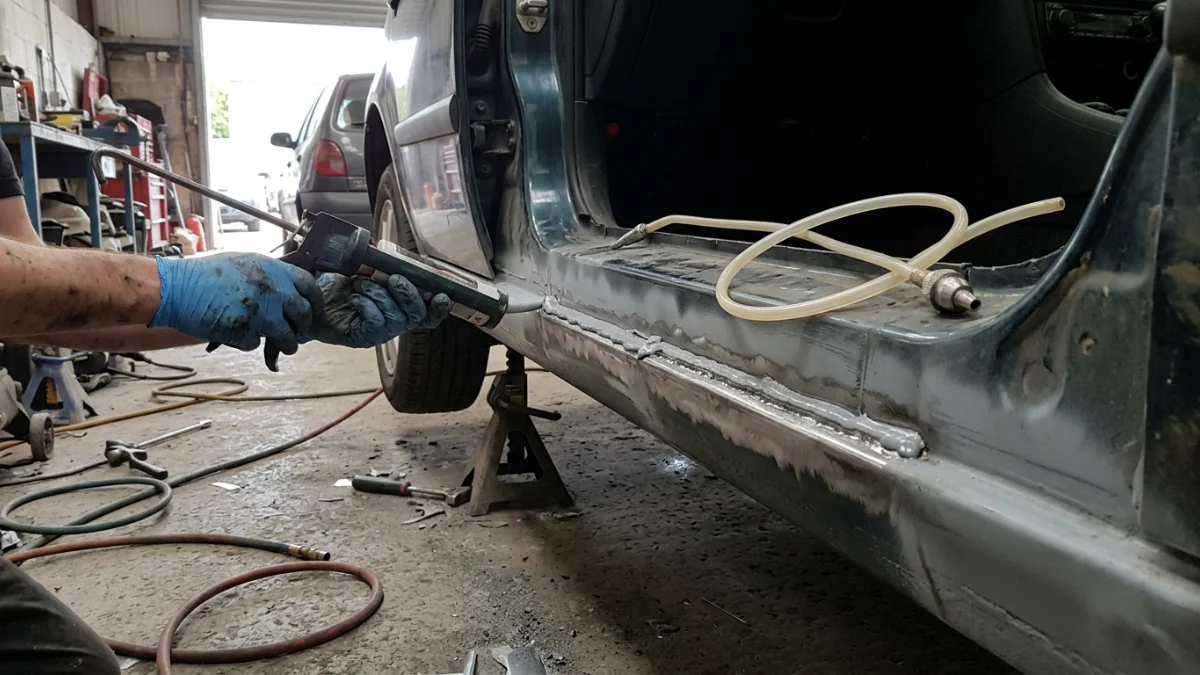
- Cavity wax. The closed section is injected with cavity wax, because the inside is where rust starts.
Those stages are the same on an arch repair and on a structural sill. What changes is the standard the weld must meet.
Structural repair or cosmetic repair
A structural repair restores metal the car relies on to hold its shape in a crash. A cosmetic repair restores metal that only has to look right and keep water out.
A structural repair
Sills, floor members, inner arches, jacking points, subframe mounting points and seat belt anchorage areas carry load. A repair there is continuous, full penetration where the factory weld was, and welded into sound steel both sides of the joint. Plated patches tacked over thin metal are not a structural repair. Where damage reaches a member rather than a skin, the question changes, as chassis damage after an accident sets out.
A cosmetic repair
Door bottoms, arch lips, wing skins and the lower edge of a boot lid are skin panels. Rust there lets water into the cavity behind, but the panel is not holding the shell together. A let in section, sealed and painted properly, is the right answer, and the finish matters more than the weld, which is paint work covered on the bodywork repair page.
Knowing which of the two you have starts with knowing where to look.
Where rust starts on a car in east Cardiff
Rust starts where water sits and air does not move. On cars coming in from Rumney, Llanrumney, St Mellons and Trowbridge it is the same list every time.
- Outer sills. The visible panel under the door. Rust shows here last, as blisters along the bottom edge.
- Inner sills and closing panels. The closed section behind the outer sill. The rot begins here, fed by water from the door.
- Wheel arches and arch lips. Grit strips the paint, then the lip rots from the folded edge where two layers trap moisture.
- Jacking points. Pressed reinforcements under the sill. They collapse rather than perforate, and a collapsed one means the inner sill has gone.
- Subframe and suspension mounting points. Load bearing faces under the floor, and the reason some cars are not worth welding.
- Door bottoms. Drain holes fill with road dirt, and the bottom seam rots from the inside out.
- Boot floor and spare wheel well. Water gets past a tired boot seal and stands in the lowest part of the shell.
- Windscreen surround and scuttle. Rust under the screen rubber is slow and awkward to reach.
That list is the same across the United Kingdom. What makes it move faster here is on the road between November and March.
Why a Cardiff winter is what rots a sill
Road salt is the cause. Salt in surface water keeps steel wet, so corrosion that takes years in dry air takes a season on a car left outside. The A48 and the M4 are gritted hardest in this part of the city, and a car driven along Newport Road in a wet January carries salt solution into every cavity an arch liner does not seal. Sills never get a dry spell to clear them, standing water at kerbsides pushes salt over the sill seam, and grit strips arch lips bare where the spray lands.
Salt attacks the finish as well as the steel. Thin lacquer fails faster once salt sits on it, so metal work and paint and spray repair work arrive in the same months. Salt also lifts the lacquer at an alloy rim edge, the usual reason for alloy wheel refurbishment in spring. A sill that is wet in November is rotting by February.
Found rust on a sill before the salt goes down?
Bring the car to Rumney and we will put it on the ramp, probe the sill and the arch, and tell you how far it has gone. Unit 4, Wentloog Buildings, Wentloog Road, Rumney, Cardiff CF3 1TH. Monday to Saturday, 9am to 6pm.
How the extent of the rust is established before anything is quoted
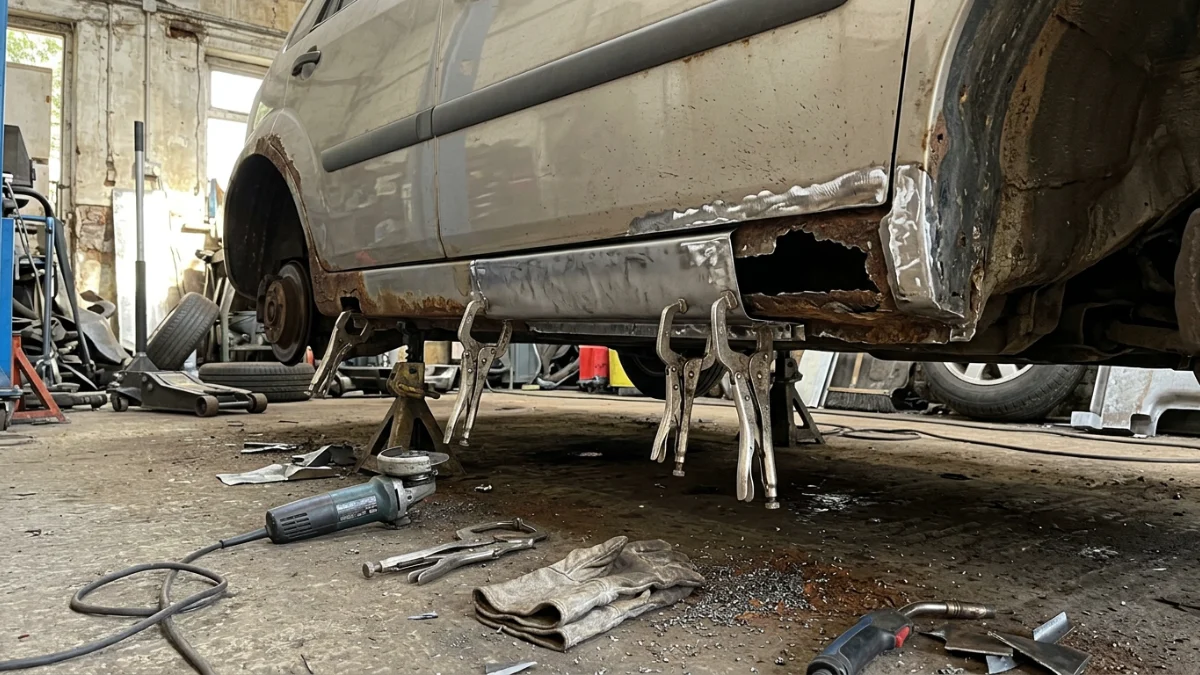
The car goes on the ramp and the corrosion is probed, because the hole you can see is smaller than the hole that is there. Four checks establish the extent.
- The ramp and a light. Both sills, both inner arches, the floor pans and the mounting faces, from underneath.
- Scraper and probe. Sound steel resists, thin steel gives, and where it gives is the edge of the repair.
- Tapping. A solid sill rings and a rotten closed section sounds dull, which maps the rot along the seam.
- Trim off. Liners, sill covers and carpet edges come off where the reading is unclear. Inner sill rot often reads from inside.
The quote follows that assessment. The damage is assessed on the car at strip down and the figure is written afterwards, never the other way round, because a price agreed before anyone has probed the seam has to change. What moves a bodywork figure is set out on bodywork repair prices.
What each level of corrosion needs
| What is found | What it means | What the repair involves |
|---|---|---|
| Blistering along a sill or arch seam | Corrosion working out of a trapped seam | Strip back to the edge, then a let in section |
| Perforation in an outer sill skin | Water has stood in the section behind it | Cut out, let in a section, seam seal, paint, wax |
| Perforation in an inner sill | Structural steel gone, outer skin next | Outer sill cut open, inner section replaced, skin rebuilt |
| Collapsed jacking point | Reinforcement and inner sill both failed | Jacking point and inner sill welded to the factory pattern |
| Corrosion at a subframe mount | Load bearing steel at a mounting face has thinned | Assessed first, and sometimes where welding is refused |
| Rot through a boot floor or inner arch | Water sitting inside the shell for years | Floor section let in, seams resealed, drains cleared |
Those categories answer what the repair is. They do not answer whether it should be done at all.
Repairable, replacement or stop: how a rusty panel is judged
Three verdicts cover every rusty panel. It takes a let in section, it needs replacing whole, or welding is not the right answer for the car.
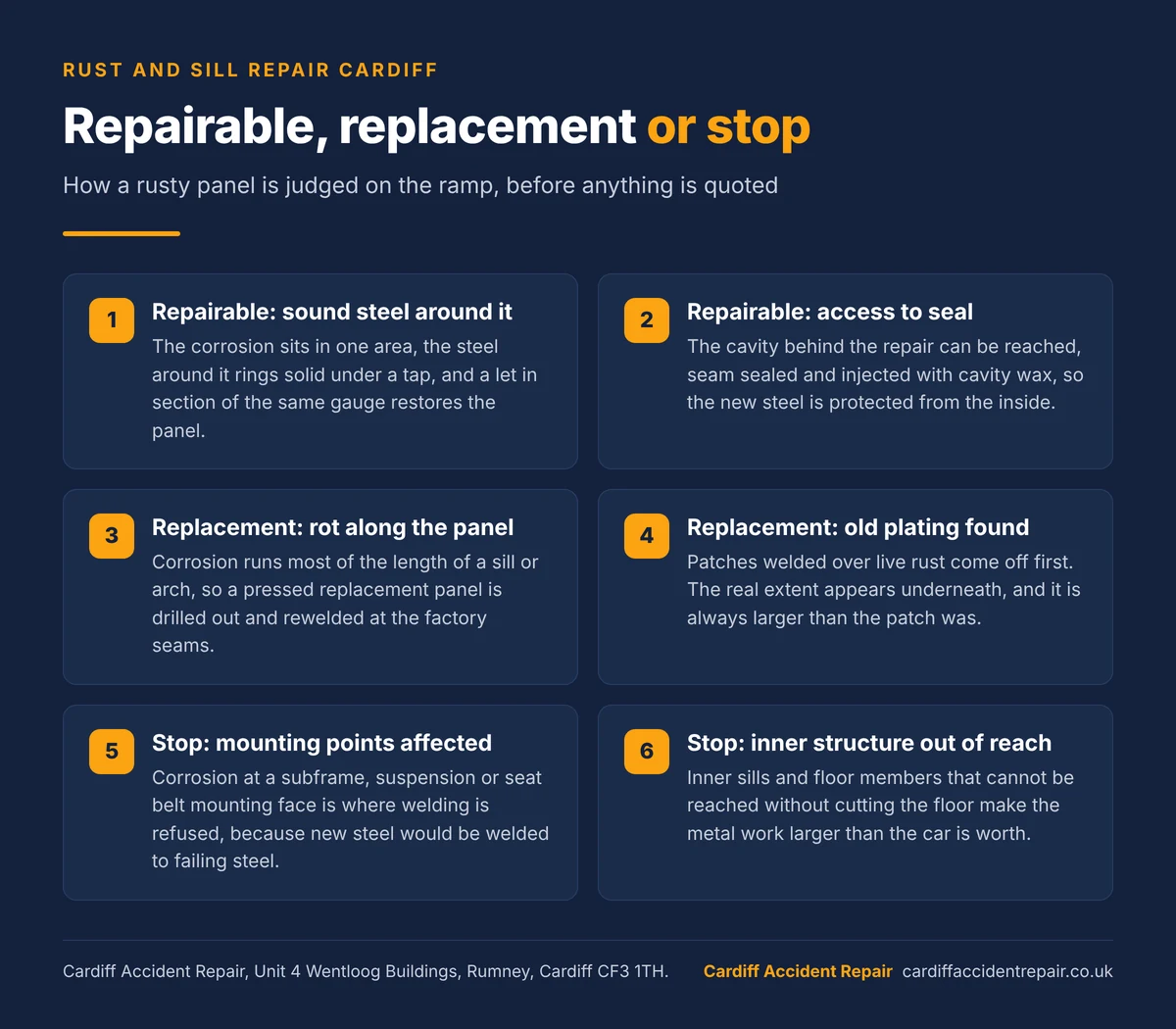
- Repairable. The corrosion sits in one area, the steel around it rings solid, and the cavity behind can be sealed and waxed.
- Replacement. The corrosion runs most of the length of the panel, or old filler and plating has to come off first.
- Stop. Several structural areas have gone, a mounting face is affected, or the inner structure cannot be reached without cutting the floor.
The third verdict is the one worth explaining.
What makes a car not worth welding
A car stops being worth welding once corrosion has reached several structural areas at once. A rotten sill with a soft subframe mount and a floor that gives under a probe is a shell that has been wet for years, and new steel would only be welded to steel on its way out.
- Corrosion at more than one mounting point. Suspension, subframe and seat belt mounting faces have to be sound. Rot across two of them is the clearest stop.
- Previous plating over rot. Patches welded over live corrosion trap it, and the real extent appears only once they come off.
- Rot on both sides at the same height. That is a shell that has stood in water, not one damaged area.
- Metal work worth more than the car. Labour on a multi section structural repair can pass the value of the vehicle, which on an insurance job is how a car reaches a write off category, as Cat S and Cat N write off categories explains.
Being told to stop is not the same as being told the car is finished. Where a panel is sound enough to be reshaped rather than cut out, the choice is set out in panel beating or panel replacement.
Rust, the MOT and corrosion near a structural mounting point
Corrosion becomes an MOT matter once it sits close to something structural. The DVSA MOT inspection manual defines a prescribed area as the area within 30cm of a structural mounting point, such as a suspension mounting, a seat belt anchorage or a subframe mount, and corrosion inside that area is judged against a stricter standard than corrosion elsewhere.
A blister on a door bottom is cosmetic. The same blister on an inner sill beside a seat belt anchorage sits in a prescribed area, and the tester has to judge whether that steel is still doing its job. Testers differ, which is how an advisory one year becomes a failure the next on a sill that has not visibly changed. An advisory means the steel is going, and it does not improve on its own.
MOT welding itself is carried out at CF3 MOT and Service Centre in Rumney, the sister workshop we work alongside rather than part of the same company, and their vehicle welding page covers the test side. Cosmetic rust, arches and paint come here.
What happens when rust is left for another winter
Left alone, a rusty sill does not stay the size it is. The closed section holds water, the rot travels along the seam both ways, and the repair grows from one let in section into a full sill, then a floor section as well.
The paint side grows with it. A full sill repair puts the door, the arch and sometimes the rear quarter into the blend, because colour has to carry across the side of the car. Flatting, blending and compounding take longer than the welding, and how a timeline is built around parts, paint and cure time is described in how long accident repair takes.
A collapsed jacking point means the car cannot be lifted safely where it was designed to be lifted. A rotten inner sill under a seat belt anchorage is a safety matter. Corrosion at an arch lip spreads into the wing, so a wing saved in November needs replacing by March. Collision damage on a rusted shell is harder again, because there is nothing solid to pull against on a jig, as the accident repair page explains. Cars come to Rumney for welding and arch work from across Cardiff, Newport, Caerphilly, Bridgend, Barry and Penarth, listed on areas we cover.
Rust on a sill, an arch or a jacking point?
Put the car in front of us and we will tell you what is repairable, what needs a full panel and what we would not weld. Unit 4, Wentloog Buildings, Wentloog Road, Rumney, Cardiff CF3 1TH. Monday to Saturday, 9am to 6pm.
Questions about rust repair and sill welding
Can a rusty sill be repaired, or does the whole sill have to be replaced?
Most rusty sills take a let in section rather than a whole new panel. The rotten steel is cut back to bright metal, a matching section is welded in, and the seam is sealed and waxed. A full sill goes on where corrosion runs most of its length.
Does corrosion fail an MOT?
Corrosion fails an MOT once the tester judges that the steel is no longer doing its job. The DVSA inspection manual holds corrosion inside a prescribed area, the area around a structural mounting point, to a stricter standard than corrosion elsewhere on the body.
Is a welded repair as strong as the original sill?
A correctly welded repair restores the strength of the section. The new steel matches the gauge of the original, the weld reproduces how the factory joined the panel, and the joint is continuous rather than tacked. Strength is lost by plating over thin metal.
Do you ever plate over rust rather than cut it out?
No. Plating over live corrosion traps moisture against the steel and the rot carries on under the patch. The repair looks finished for one winter and then lifts, and the area that comes out second time is larger than the first.
Will the rust come back after the repair?
Rust returns where the cavity behind a repair is left bare. Bare steel takes etch primer, every joint takes seam sealer where the factory sealed, and the closed section is injected with cavity wax. Blocked drain holes are cleared at the same time.
Can you tell from photographs how far the rust has gone?
Photographs show where to start looking and little more. Corrosion works outwards from inside a closed section, so the paint fails last and the blister is smaller than the affected area. Send photographs with the registration and we will give the likely category.
Rust is at its smallest in the month you notice it, and always larger under the paint than on top of it. The workshop is at Unit 4, Wentloog Buildings, Wentloog Road, Rumney, Cardiff CF3 1TH, open Monday to Saturday, 9am to 6pm. Call 07400 454839 or use the contact form.
Two related guides go with this page. How to spot early car rust covers the seven places to look before it becomes metal work, and wheel arch rust repair covers the arch lip specifically, where filler, a repair panel and a full section each have an honest use.