
Accident Repair for Caerphilly Drivers
The road between Caerphilly and Cardiff goes over a mountain, and that single fact explains most of what arrives at the workshop from this direction. That means underbody damage from a verge or a kerb taken at the wrong angle, animal strikes on the lanes, and the low speed contact that happens when traffic stops suddenly on a gradient. The drive down to the Rumney workshop is twenty five to thirty minutes off peak, and a car that is off the road should not attempt the descent at all. Ali Hindal runs six work bays and an on-site spray booth at Unit 4 Wentloog Buildings, CF3 1TH, and your quote follows the strip down rather than a look over the bonnet.

The drive from Caerphilly to Rumney
Twenty five to thirty minutes off peak, on the A469 south over the mountain and then the A48 east. Add fifteen to twenty minutes in rush hour, most of it on your descent and the Thornhill approach rather than at our end.
The alternative is the A468 east towards Newport and then the M4 and the A48 west, which is longer in miles and often shorter in minutes when the mountain is queueing or the weather is poor. In winter it is frequently the sensible choice.
Rumney sits on the eastern side of Cardiff, so from Caerphilly you are coming down and across rather than into the middle of the city. Directions from each approach, and the options if the car cannot be driven, are on the areas we cover.
What the mountain road does to cars
It punishes the parts of your car that nobody inspects: the underside, the suspension mountings and the brakes. A gradient taken repeatedly finds weaknesses that flat driving never would.
Two kinds of damage come down that road. The first is contact damage, where a car has clipped a verge, a kerb or a stone on a bend and taken the hit on a sill, a wheel or an arch. The second is the slow kind, where your car has been worked harder than you realise and something marginal becomes a failure at the worst moment.
The repair side only deals with the first. What matters there is that a sill or an arch is structural in a way your door skin is not, so a scrape low down on the body is worth a proper look rather than a quick refinish. The difference between cosmetic and structural damage is set out in chassis damage after an accident.
Animal strikes on the lanes
Hitting an animal is treated differently in law depending on what you hit, and most drivers get this wrong at the roadside. Some species must be reported to the police and some need not be.
The duty to report applies to a specific list of animals rather than to all of them, so if you hit a dog or a sheep you are not in the same position as if you hit a cat or a fox. Getting it wrong at two in the morning on a dark lane is understandable and it can still be an offence, which is why the list is worth knowing before you need it.
On the car side your damage is almost always worse than it looks, because the impact is low, central and often under the bumper. Cooling packs, radiator supports and air conditioning condensers sit in exactly the wrong place. What the law requires and what the damage usually costs is set out in hitting an animal and the damage it causes.
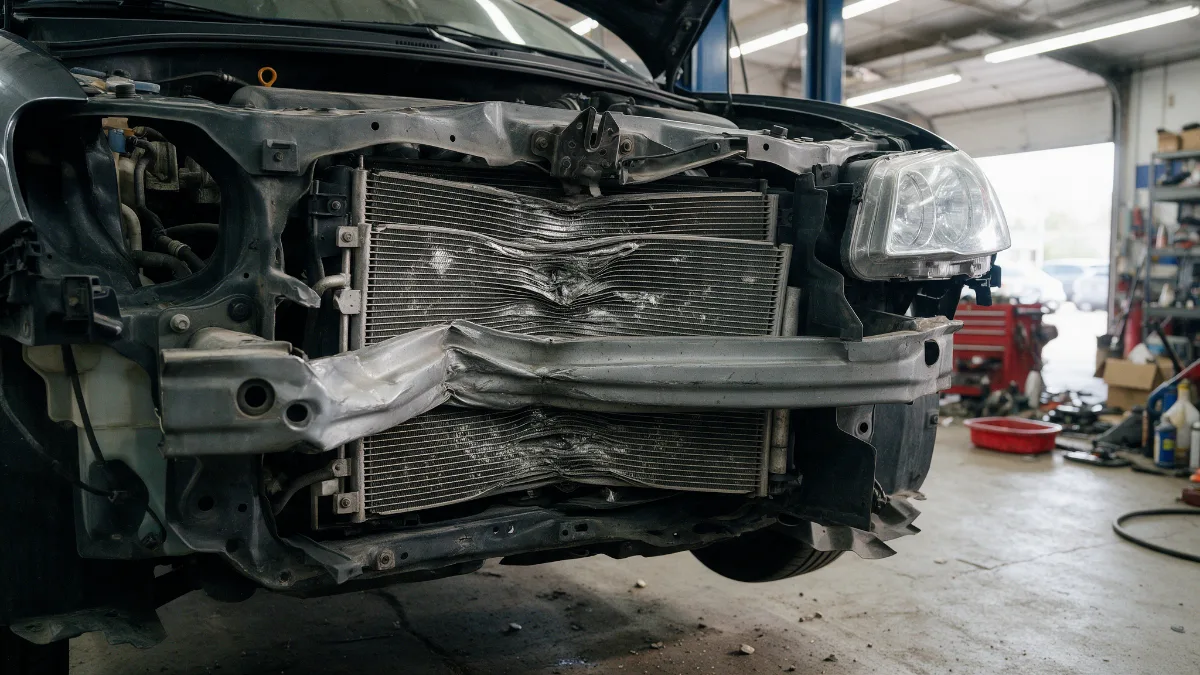
Underbody damage you cannot see from the driveway
Put the car on a ramp, because almost nothing that matters underneath it is visible from a crouch on your drive. A kerb strike that left a scuff on your wheel can also have moved a suspension arm.
Three things get checked after a verge or kerb impact. Whether your wheel and tyre survived, including the inner rim face that you cannot see with the wheel on the car. Whether the suspension geometry is still within tolerance, which shows as uneven tyre wear and a steering wheel that sits off centre. And whether the sill or the floor has taken a load, which is a different category of repair entirely.
None of that is expensive to check and all of it is expensive to ignore once you are driving on it. Where a wheel is the only casualty, what putting it right involves is on alloy wheel refurbishment.
If the car is stuck on the mountain
Get it off the carriageway and call your breakdown provider or insurer, because recovery on a road with no hard shoulder and poor sight lines is not a job to improvise. A car stopped on a bend is a hazard to everybody behind it.
Where recovery takes the car first is rarely where it should end up. Operators default to the nearest yard, and storage is charged by the day against your settlement rather than theirs. Tell whoever arranges the recovery that the car is going to a named repairer and give them the address, which saves a second move and a week of charges.
Do not sign a replacement vehicle agreement at the roadside without reading it. A hire arranged in the moment can be a credit hire contract that attaches the charges to you personally if the claim later fails, which is a different animal from a courtesy car. The difference between the two agreements is set out in courtesy car against credit hire.
Road damage claims in Caerphilly county borough
Caerphilly County Borough Council is the highway authority for roads in the borough, so a pothole claim for a wheel or a tyre goes to the council. Trunk roads and motorways are the exception, because those belong to the Welsh Government through the South Wales Trunk Road Agent.
The practical point for anybody commuting into Cardiff is that a single journey can cross both. Know which authority held the road where the damage happened before you write, because a claim sent to the wrong body comes back weeks later with the defect long since filled.
Claims turn on evidence and on the inspection defence. Photograph the defect with something in shot for scale, record the date, time and direction of travel, and keep the repair invoice. Expect the authority to argue that it had a reasonable system of inspection, because that is what the law allows it to argue.
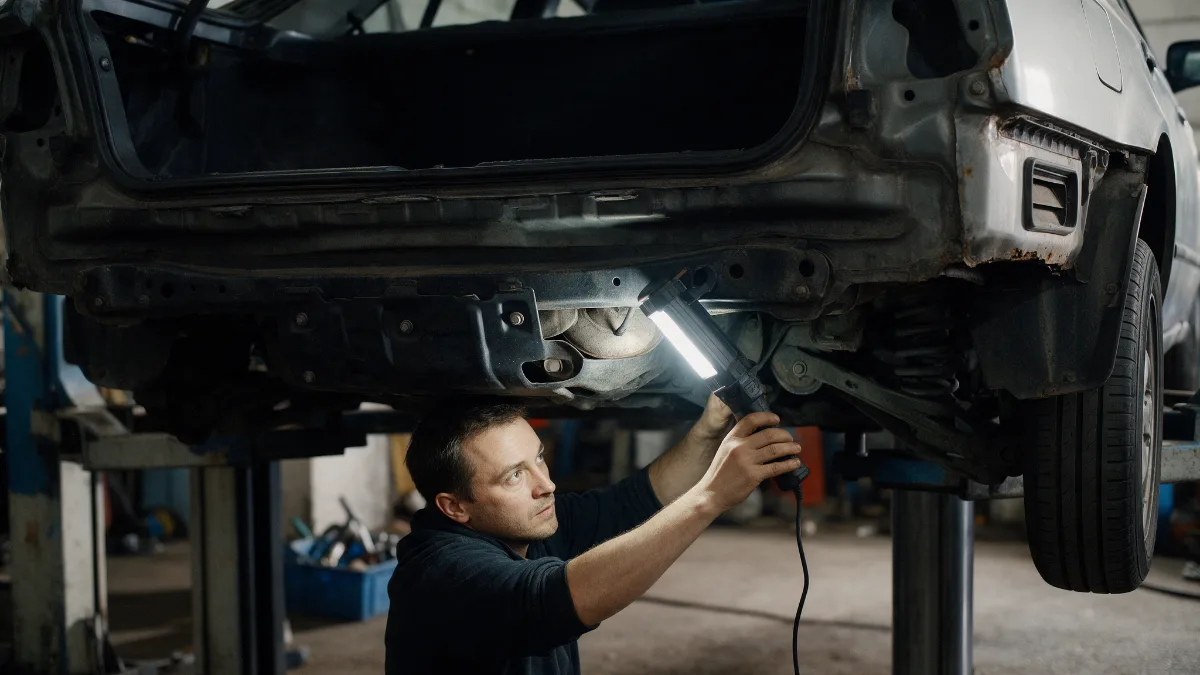
What Caerphilly customers bring in most
Front end damage, wheels and sill work. It is a different mix from the car park dents that come in from inside the city, and your front end job is usually heavier than it first appears.
Front end work after a low impact means getting the bumper off before anybody quotes, because the bumper skin is the cheapest thing behind the number plate. Your bumper bar, crash absorbers, radiator support, cooling pack and the sensors in the bumper face all sit in the firing line, and three of those are invisible with the bumper on.
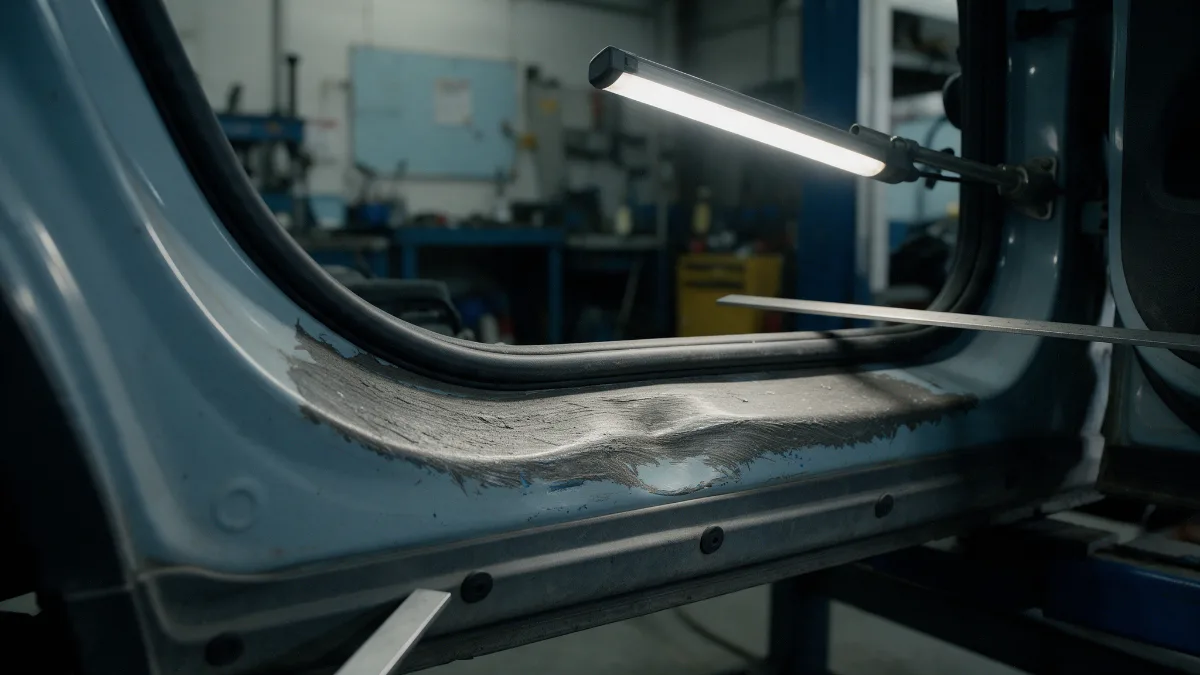
Sill and arch work is the one you are most likely to underestimate, because a scrape that looks like paint can be a deformed structural member underneath. On newer cars the front end repair ends with a calibration stage for any radar or camera that was disturbed, which is explained in ADAS calibration after accident repair.
Quotes by photograph before you come down
Send photographs and we will tell you what category the job falls into before you commit to the drive. A firm figure needs the bumper off, which is the honest answer on nearly every front end job.
Daylight, straight on and from both sides, plus one wide shot that shows where the damage sits on the car. Kneel down and photograph under your front bumper as well, because that is where a low impact actually lands. If a wheel is involved, photograph the face and the inner rim. A short guide to photographs that are worth sending is at how to photograph car damage for a quote.
Claiming when the accident was not your fault
Use the other driver insurer rather than your own where you can, because a claim on your own policy is logged as a fault claim until your insurer recovers the money, and recovery is not automatic or quick.
That label matters more than most drivers realise. Your unprotected no claims discount can lose about two years of accumulated benefit while the claim sits unrecovered, and nobody writes to tell you when the position is corrected. On a rural collision where the other driver has gone or the facts are disputed, the recovery can take months.
Evidence is what shortens it. Dashcam footage, photographs of both vehicles where they stopped, and the names of any witnesses are worth more than a detailed account written a fortnight later. How the non-fault route works, and the trap in the word fault, is on non-fault accident repairs.
Winter on the mountain road
The damage changes with the weather rather than with the driver, and the most common winter job from this direction is low speed contact in queueing traffic on a gradient. Second is a verge strike on a bend that was fine in September.
Cold surfaces, standing water and leaf fall on the apex of a bend all reduce your grip on a road where you are already committed to a line. Add a car in front stopping harder than expected on a slope and the result is a bumper, a bonnet leading edge and sometimes a radiator support.
Salt and grit add the slower problem. Grit chips paint on sills and arch lips, salt then works at the chip, and by spring a mark that was cosmetic in November has lifted. If your car does the mountain daily, dealing with chips before the winter is cheaper than dealing with them after it.
Book an accident repair from Caerphilly
We are at Unit 4 Wentloog Buildings, Wentloog Road, Rumney, Cardiff CF3 1TH, Monday to Saturday, 9am to 6pm, with six work bays and the spray booth on site. Come down the A469 and take the A48 east to the Rumney turn, or use the A468 and the M4 if the mountain is queueing. If the car is not fit for the descent, ring us before you set off. The full range of collision work is on accident repair.
Questions from Caerphilly drivers
Do I have to report hitting an animal?
It depends on the animal. The duty to stop and report applies to a specific list rather than to every creature, and a dog is treated differently from a cat. Check the list before you need it rather than at the roadside.
I clipped a kerb on the descent. Is a wheel scuff all it is?
Often not. The same impact can move suspension geometry or damage the inner rim face, neither of which shows with the wheel on the car. It is a short check and a cheap one.
Who do I claim from for a pothole on the mountain road?
Caerphilly County Borough Council for borough roads. If the damage happened on a trunk road or a motorway, the claim goes to the Welsh Government through the South Wales Trunk Road Agent.
Is the drive down worth it when there are closer shops?
Use a closer shop if it can do the work properly. The reasons to come to us are the booth, the welding and the measuring, which matter on front end and sill damage rather than on a bumper scuff.
My car is not safe to drive. Can you arrange recovery?
Recovery is arranged through your insurer or breakdown provider rather than by us, but tell them the car is coming here and give them the address, because it saves a second move and a week of storage.
Why does a low speed animal strike cost so much?
Because the impact goes under the bumper into the cooling pack, the radiator support and the condenser, which are expensive parts sitting in the most exposed place on the car.
Photograph under the front bumper as well as the front of it, get the car on a ramp after any kerb or verge strike, and find out which authority held the road before starting a claim. Call 07400 454839 or use the contact form.